The intelligent content supply chain
How generative AI is rewiring pharma commercial content, from creation to intended HCP behavioral shift
A strategic and technical guide for pharma commercial and AI leaders
April 2026
Authors
Deependra Singh
International Data Science Lead, Pfizer
Deepak Panigrahi
Principal AI Consultant - Pharma, Fractal Analytics
The content engine is broken, and AI is the architectural fix
The pharmaceutical content supply chain was never built for the commercial environment we operate in today.
A single promotional asset, whether a branded email, clinical summary, or detail aid with global citations and local adaptations, can require 8 to 14 weeks from brief to deployment. Multiply this across multiple indications, markets, languages, and 8+ engagement channels, and the result is a structurally constrained content engine that cannot keep pace with the velocity of modern HCP engagement.
At the same time, physicians navigate more than 300 commercial touchpoints per week across fragmented digital and in-person channels. Tolerance for generic, poorly timed, or clinically shallow messaging is declining rapidly. The brands earning sustained HCP mindshare are not those with the largest content budgets, but those with the most intelligent content operations.
Generative AI, when applied with architectural discipline across the full content lifecycle, is the enabling technology that transforms this system.
Five stages of the intelligent content lifecycle
01
Content creation
LLM-powered authoring, RAG-grounded accuracy, and modular content at scale.
02
Content tagging
Semantic metadata and the content intelligence graph.
03
ML-Augmented Regulatory Review (MLRE)
Faster cycles, smarter routing, human-governed intelligence.
04
Omnichannel orchestration
HCP digital twins, Next-Best-Content AI, and agentic engagement.
05
Performance and measurement
Causal attribution, closed-loop intelligence and AI-native KPIs.
Each stage is examined with sufficient technical depth to inform architectural decisions, and sufficient commercial framing to connect capability to measurable impact.
Core principle
The future content supply chain is not a linear pipeline. It is a living intelligence system, one that creates, learns, adapts, and compounds with every HCP engagement.
Stage 1 — Content creation
Traditional pharma content creation is intentionally cautious and sequential: briefing, drafting, medical alignment, legal refinement, regulatory shaping, often before the asset even reaches formal MLR review. The process ensures compliance, but at the cost of speed and scalability. Generative AI fundamentally changes the economics, but only when architected correctly.
Retrieval-Augmented Generation (RAG) architecture
Large Language Models (LLMs), fine-tuned on brand, medical, and regulatory corpora can produce scientifically coherent, brand-aligned drafts in minutes. However, production-grade deployment requires Retrieval-Augmented Generation (RAG).
Before generating a single word, a RAG system retrieves relevant approved claims, label language, and clinical evidence from a curated knowledge base. The model grounds its output explicitly in this retrieved context. This ensures factual traceability, not from model memory, but from verifiable source documentation.
Technical note: robust RAG architecture
Keyword-based retrieval for exact regulatory phrasing
Semantic vector search for conceptually aligned evidence
Context window structuring to maintain label fidelity
Every generated clinical claim can be traced to an approved label section or source document, meeting compliance requirements by design.
Modular Content Framework (MCF)
On top of RAG sits a Modular Content Framework (MCF). Rather than generating entire campaign assets, AI produces atomic, pre-structured modules: primary claims, data blocks, MOA explanations, fair balance segments, and calls to action, each designed within predefined templates. Modules are independently approved, tagged, and stored for recombination across markets and channels.
This architectural shift:
Eliminates redundant recreation
Enables reuse at scale
Shortens adaptation cycles
Supports personalization without re-authoring
Organizations implementing modular, RAG-grounded authoring report:
Reduction in content creation timelines
30–45%
Reduction in first-pass MLR rejection rates
Equally important, AI pre-screens drafts for predictable compliance risks, missing ISI elements, off-label phrasing patterns, and unsubstantiated claims, before human review. The objective is not to replace compliance judgment, but to remove avoidable friction so human expertise is applied where it matters most.
Stage 2 — Content tagging
Tagging is the least visible and most strategically consequential stage of the content supply chain. Without standardized, machine-readable metadata, personalization engines cannot select effectively, compliance systems cannot route accurately, and measurement systems cannot attribute meaningfully. In most organizations, tagging remains manual, inconsistent, and retrospective, silently constraining every downstream AI capability. AI-driven tagging transforms metadata into a real-time intelligence layer.
Five metadata dimensions
1
Clinical attributes
Indication, MOA, claim type, and data source.
2
Compliance attributes
ISI completeness, substantiation tier, and market scope.
3
Channel suitability
Format, device optimization, and length.
4
Audience alignment
HCP specialty affinity and journey stage.
5
Lifecycle governance
Approval version, expiry triggers, and localization scope.
Technical note: The tagging pipeline
Named Entity Recognition (NER) for clinical concept extraction
Multi-label classifiers for claim typing and channel suitability
Ontology linking to MeSH, RxNorm, and other standardized vocabularies
LLM-based qualitative tagging for nuanced contextual assessment
The Content Knowledge Graph
The evolution beyond flat metadata is the Content Knowledge Graph. In a graph architecture, assets, claims, evidence sources, personas, performance metrics, and markets are interlinked nodes. This enables compound queries such as:
“Find approved, label-supported efficacy email modules for this indication, optimized for safety-focused cardiologists in the early adoption stage, with historical open rates above segment baseline.”
What would require multiple database joins resolves as a single graph traversal. Vector embeddings further enable semantic retrieval, surfacing conceptually relevant content even when exact keyword matches do not exist. This is particularly powerful for rare specialties and emerging scientific narratives.
Core principle
A content tag is a machine-readable contract that defines what an asset is, who it is for, where it can be deployed, how it performs, and how long it remains valid.
Stage 3 — ML-Augmented Regulatory Review (MLRE)
Faster cycles, smarter routing, human-governed intelligence
The MLR process is where most supply chains stall.
Sequential Medical → Legal → Regulatory review, often operating in silos, can extend cycles to 3–6 weeks per asset. In a digitally responsive commercial environment, this latency erodes competitiveness.
MLRE does not remove human reviewers. It augments them.
AI contribution points
Pre-submission screening
Automated analysis flags structural gaps, prohibited language, off-label risks, and missing substantiation, thereby resolving predictable issues before they enter the review queue.
Claim substantiation intelligence
For each claim, the system retrieves supporting evidence and applies Natural Language Inference (NLI) models to assess the strength of alignment. Reviewers see:
The claim
Its evidence base
Alignment scoring and
Highlighted risk areas
Intelligent parallel routing
ML-based risk profiling enables conditional routing:
Medical and Regulatory in parallel
Legal is triggered only when risk signals require it
This structural redesign alone reduces total cycle time by 25–35%.
Precedent intelligence
Retrieval systems surface how similar claims were handled previously, approved phrasing, rejected language, and accepted alternatives, creating institutional compliance memory across markets.
All AI outputs are advisory, carry confidence scores, and maintain full audit trails. Reviewer overrides are logged and used to continuously refine models.
Organizations implementing MLRE report:
Reduction in review cycle times
Cross-market consistency
Reviewer fatigue
The objective is not speed at the expense of rigor. It is speed with defensible rigor.
Stage 4 — Omnichannel orchestration
HCP digital twins, next-best-content AI and agentic engagement
Content stored in a DAM generates no commercial value. Value emerges only when content meets the right HCP at the right moment.
The foundation of intelligent orchestration is the HCP digital twin, a continuously evolving AI-constructed profile integrating:
Digital engagement history
CRM and field interactions
Prescribing and claims data
Congress and publication signals
Channel responsiveness patterns
This is not static segmentation. It is a real-time persona model.
Technical note: HCP profiles
HCP profiles are maintained in a real-time feature store, enabling millisecond-level content selection decisions. Privacy-preserving data clean rooms enable secure integration of prescribing data without moving raw data.
The Next-Best-Content (NBC) engine
The NBC engine intersects the content graph with the HCP digital twin. Using reinforcement learning, the system optimizes asset selection, channel, and timing based on reward functions tied to commercial outcomes, such as prescription lift and journey progression, rather than vanity engagement metrics.
The engine selects only from:
Approved content
Consent-compliant records
Frequency-capped interactions
Market-valid assets
Agentic orchestration
AI constructs personalized engagement pathways, monitors signals, adapts sequencing dynamically, and triggers enriched rep alerts when human interaction would add disproportionate value.
Strategic shift
AI moves from supporting campaigns to orchestrating relationships, with human expertise deployed at moments of highest clinical complexity.
Stage 5 — Performance and measurement
Causal attribution, closed-loop intelligence and AI-native KPIs
Legacy measurement frameworks track activity: opens, clicks, calls. Intelligent supply chains measure influence.
A mature AI-native measurement framework operates across three tiers
Tier
Measurement layer
What is measured
Tier 1
Engagement intelligence
Granular consumption depth:
Video completion
Dwell time per module
Cross-channel behavioral fingerprints
Unified persona-level engagement scoring
Tier 2
Behavioral influence metrics
Connecting content sequences to:
Prescribing shifts
Clinical inquiries
Competitive consideration dynamics
Tier 3
Commercial outcome attribution
Moving from last-touch attribution to probabilistic, multi-touch contribution modeling.
Technical note: Causal impact
Causal inference techniques, including propensity score matching and geo-lift testing, isolate the impact of content from confounding factors in prescribing.
The closed intelligence loop
The most powerful capability is the closed intelligence loop:
Underperforming modules trigger AI-generated root-cause analysis
High-performing modules gain weighting in NBC selection logic
Micro-segment opportunities are surfaced
Persona models continuously refine
Creation briefs incorporate performance intelligence
AI-native KPIs
CEQ
Content Effectiveness Quotient
PRI
Persona Resonance Index
JVS
Journey Velocity Score
AWRI
Attribution-Weighted Revenue Impact
Meta-metric: If CEQ, PRI, and AWRI compound quarter-over-quarter, the supply chain itself becomes a competitive moat.
The content intelligence flywheel
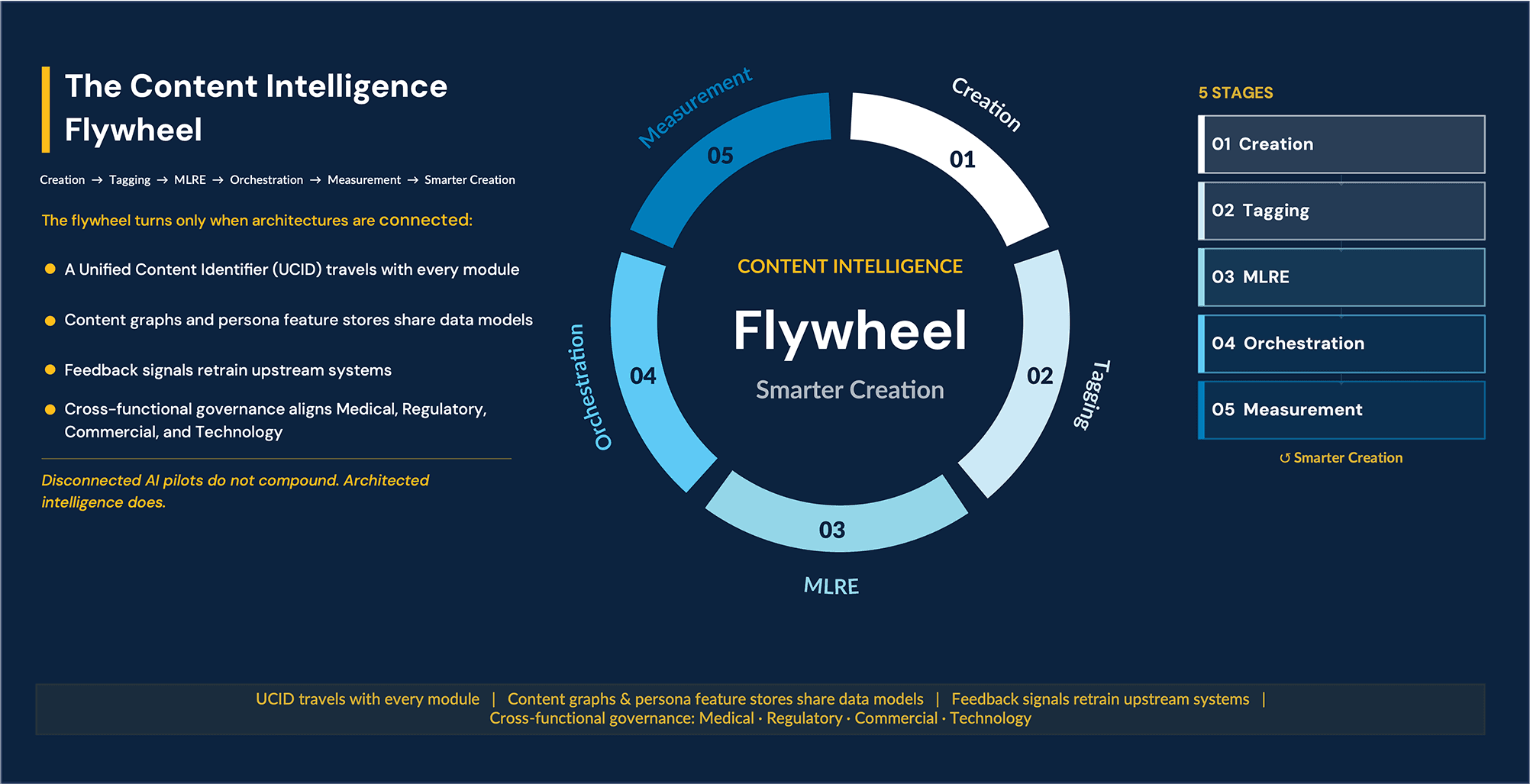
The five stages form a flywheel
The flywheel turns only when architectures are connected:
A Unified Content Identifier (UCID) travels with every module
Content graphs and persona feature stores share data models
Feedback signals retrain upstream systems
Cross-functional governance aligns Medical, Regulatory, Commercial, and Technology
Disconnected AI pilots do not compound. Architected intelligence does.
The imperative: Architecture over tools
RAG authoring, semantic tagging, MLRE acceleration, persona-driven orchestration, and causal attribution are enterprise-deployable today.
The risk is not moving too fast.
The risk is building disconnected pilots that never converge into an intelligence system.
The next decade of pharma commercial leadership will not be defined by who adopted AI tools first, but by who architected a self-reinforcing AI content supply chain.
Stop investing in
isolated AI tools
Start investing in
AI architecture
The tools matter.
The connective tissue that makes them compound matters more.
What comes next
The intelligent content supply chain is only the visible layer of a much deeper transformation. Behind the five-stage framework sit equally critical questions that will define competitive advantage over the next decade:
How should Responsible AI governance be structured in regulated commercial environments?
What operating model changes are required as marketers become journey designers and reviewers become AI-augmented risk stewards?
How should organizations quantify ROI beyond efficiency gains and tie AI-enabled content intelligence directly to launch curves and lifecycle value?
What does a true AI maturity roadmap look like for global pharma organizations at different stages of transformation?
These questions move the conversation from capability to enterprise design. In a follow-up article, we will explore the governance architecture, change-management imperatives, capital-allocation logic, and maturity models required to turn an intelligent content supply chain into a durable commercial advantage.
The technology is ready. The structural transformation is just beginning.
Build the intelligent content supply chain
Accelerate HCP engagement intelligently