A category manager arrived at what should have been a routine quarterly review, three weeks of work prepared: forty slides, share movements explained to the second decimal. The buyer across the table let four slides pass before she interrupted: “We saw this two weeks ago. What matters now is what the supplier plans to do about it.”
A supplier can lose influence without losing a point of share. The loss happens on speed.
She had seen the shift in her own data first. The shift was real, but neither bad nor surprising, just slower in the supplier narrative than in the retailer narrative. That drive home revealed an uncomfortable truth: a supplier can lose influence without losing a point of share. The loss does not happen on products. It happens on speed.
The uncomfortable truth
That moment has played out thousands of times across CPG since. Many category teams have never had more data and never had less influence. They have optimized for better analysis when the buyer stopped asking “what happened?” years ago. The average quarterly review now answers questions retailers are not even asking anymore.
Why now: Three shifts at once
Three things have converged in the past two years:
AI became conversational. A category manager can now interrogate data the way they would interrogate an analyst, collapsing weeks of analysis into minutes.
Retailers now out-data their suppliers. First-party transaction and loyalty data has inverted a forty-year information advantage.
Signals can finally be connected. Point of sale, shelf images, weather, social, and inventory are now joinable in near real time.
Together, these do not improve category management. They redefine it entirely.
The operating model: A weekend replayed
Here is the new rhythm in practice, and every component already exists somewhere:
Friday evening.
A competitor launches a surprise promotion. By Saturday morning, a connected system has flagged it alongside a cold front suppressing impulse traffic, a display-compliance drop in forty stores.
Saturday afternoon.
Three intervention plans exist: simulated, costed, and ranked not by brand benefit but by category growth for the retailer.
Monday at 7 AM.
The category manager arrives, approves the strongest scenario, and adds the one line no model could write: Delay one region. Their seasonal reset starts next week.
By 8 AM.
The merchant has a brief in her inbox. Her reply: How did you know?
Week 4 Timestamp
The merchant has a brief in her inbox. Her reply: How did you know?
When she pushes back. What happens if fuel prices rise? The scenario updates in the room and holds under scrutiny. Trust that once took three review cycles to build now compounds in a single conversation.
The future does not belong to the companies with the smartest AI. It belongs to the companies whose AI makes merchants trust them more.
Four shifts in rhythm
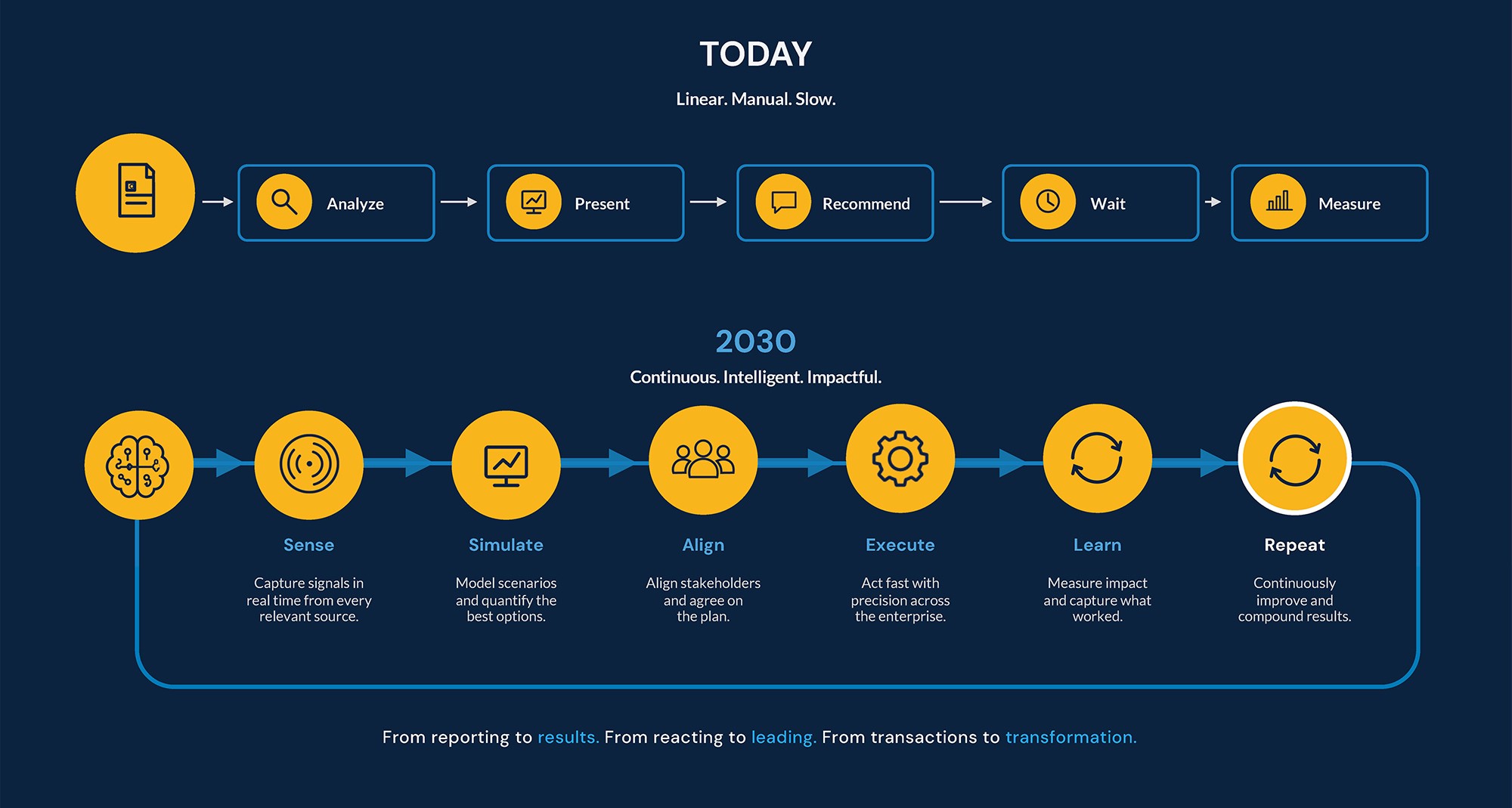
From reporting to simulation. The buyer stops asking what happened and starts asking what if?
From insights to interventions. The output is not a finding. It is a decision, teed up and costed, ready to execute.
From quarterly to continuous. The category is managed every day. Reviews become checkpoints, not the work itself.
From supplier to growth partner. The goal shifts from optimizing your share to optimizing the retailer category.
When demand intelligence becomes continuous, planning, sales, supply chain, and revenue management stop behaving like separate functions and start operating as a single commercial learning system with category management at its center.
The actual advantage: Learning speed
When category management was first being reimagined from a supplier perspective, the assumption was clear: advantage belongs to whoever has the best models.
Models, it turns out, are rentable. Within a few years, every serious CPG company will run on roughly the same AI and intelligence.
What cannot be rented is the loop. The first recommendation a system makes is valuable. The thousandth is transformational. That accumulated commercial learning and the merchant trust it earns is the asset a fast follower cannot buy.
Everyone will have the models. The winners will be whoever learns fastest.
What the best are already doing
The leaders map neatly onto the loop itself:
Sense: P&G. Computer-vision shelf systems turned manual store audits into smartphone snapshots, improving audit efficiency by 75%. What the shelf sees feeds directly into demand forecasting. The lesson: make the shelf a sensor and let one signal power many decisions.
Predict: Unilever. Weather-driven forecasting and data from 100,000 AI-enabled freezer cabinets have lifted retail orders and ice cream sales by 8-30% depending on market. Its AI social listening turned Crumbl cookie fandom into a Walmart-exclusive Dove range that hit its six-month sales target in one month. The lesson: the outside world is category data.
Act: Amazon. Its foundation forecasting model positions hundreds of millions of products before orders exist, improving regional forecasts for popular items by 20%. Machine learning saved the company 1.6 billion dollars in transportation and logistics costs in a single year. The lesson: prediction only matters if the system can act on it.
Learn: Unilever (Mexico). An AI replenishment engine generating millions of forecast combinations daily now triggers restocking across the country, delivering 98% on-shelf availability and 12% sales growth in under a year. A supplier intelligence wired into the retailer operation, learning from every cycle. That is the destination.
Week 4 Timestamp
The merchant has a brief in her inbox. Her reply: How did you know?
None of these capabilities required a breakthrough model. They required connecting what already exists. The constraint is organizational, not technological.
What AI will not fix
Two honest limits, born from experience:
Retailers will not move at machine speed. The prize is preparedness. When the merchant is ready to decide, your scenarios are quantified while a competitor opens a blank spreadsheet.
No retailer will trust a supplier AI. Retailers will trust a supplier's people, using AI transparently: the person still willing to take a position and defend it. Negotiation, storytelling and judgment on uncertain days become the scarcest skills.
One more shift is coming: a growing share of shopping will soon be done by AI agents acting on shoppers' behalf. An agent does not browse a shelf; it parses product data. Category managers will find themselves optimizing for how algorithms interpret products as much as how shoppers see them.
The cost of waiting
Organizations that keep treating category management as a reporting function will not lose because their analytics are worse. They will lose because someone else will reach the merchant with a decision while they are still formatting the deck.
The best compliment any category manager can receive is from a buyer who starts calling before her internal planning meetings. That relationship, industrialized and systematized, is the destination: a partner that helps the retailer grow the category better than the retailer can alone.
For three decades, category managers were measured by how well they explained yesterday. The next decade will reward the ones who help retailers decide tomorrow.
What will your biggest retailer expect from you in five years that they do not expect today?
Sources and attribution
Company examples reflect publicly reported figures; vendor-published case studies are noted as such.
Unilever (weather forecasting & AI freezers): “How AI is transforming Unilever Ice Cream’s end-to-end supply chain,” Unilever newsroom, Jan 2025 — weather-driven forecast accuracy +10% (Sweden); 100,000 AI-enabled freezers; sales lifts of 8% (Turkey), 12% (US) and 30% (Denmark). See also “Our AI-enabled freezers are revolutionising ice cream sales,” Unilever newsroom, Aug 2024.
Unilever / Dove × Crumbl: “Dove x Crumbl wins new generation of social-first shoppers,” Unilever newsroom, Sep 2025 — Walmart-exclusive; six-month sales goal hit in one month; 52% of buyers new to Dove. “No.1 launch this year for Dove” and the social-listening origin: “Using social insights to meet changing consumer behaviours,” Unilever newsroom, Jul 2025.
Unilever Mexico replenishment: “How Unilever is using AI to drive food supply chain innovation,” GreyB (analysis) — neural-network replenishment delivering 98% fill rates, 98% on-shelf availability and 12% sales growth in under a year.
P&G shelf intelligence: “Procter & Gamble Uses AI Agents: 10 Ways to Use AI,” Klover.ai (analysis), 2025 — 75% improvement in shelf-audit process efficiency; shelf data feeding demand forecasting. Underlying vendor case study: Impact Analytics, “P&G Improves Process Efficiency by 75%.”
P&G Supply Chain 3.0: “P&G shifts Supply Chain 3.0, other platforms into large-scale rollout,” Supply Chain Dive, May 2026 — 98% on-shelf and online availability target and up to $1.5B in cost-of-goods savings.
Amazon: “Amazon announces AI-powered innovations in delivery, inventory, robotics,” About Amazon (official), Jun 2025 — foundation forecasting model: +10% national forecasts for deal events, +20% regional forecasts for millions of popular items. $1.6B saved in transportation and logistics costs in 2020 via machine learning: Sifted, “How Amazon Is Using AI to Become the Fastest Supply Chain in the World.”
AI shopping agents: “2026 CPG Marketing Formula #4: Preparing for Agentic Commerce,” Skai (analysis) — agent visibility could shift 15–30% of category purchases within 3–5 years in convenience-led CPG categories; figures are directional.