Last year, consumer goods companies invested billions of dollars in AI. They built better forecasting models. Smarter pricing engines. More sophisticated demand sensing. AI copilots for sales teams. Computer vision for shelf audits.
Yet when I sit down with CPG executives, I hear the same frustration.
We're generating more insights than ever, but we're not making better decisions any faster.
The hidden cost of organizational friction
Here's what I see across CPG companies: every quarter, sales planning approves promotions using assumptions that field sales already know are wrong. Every week, category managers analyze reports describing what happened two weeks ago. Every month, competitors capitalize on opportunities your headquarters hasn't yet recognized.
A competitor secures premium placement. Within hours, their field organization adjusts displays. Within a day, their supply chain reallocates inventory. Within forty-eight hours, their category team updates forecasts. Your company is still in meetings deciding whether to respond.
Why this matters financially
The cost of organizational friction shows up in multiple places on the P&L.
First-mover advantage matters.
The supplier who recognizes changing demand first adjusts inventory first. The one who responds to competitive pressure first protects shelf space. That's the difference between gaining share and losing it.
Working capital gets trapped.
When signals travel slowly, inventory sits in the wrong locations. Safety stock accumulates to compensate for poor forecasts. Dead stock from canceled promotions that shipped before anyone recognized they should cancel. For a billion-dollar CPG, organizational latency means millions of dollars tied up in working capital.
Retailer relationships shift.
Responsiveness is one factor that strengthens retailer partnerships and increases a supplier's ability to influence category decisions. The partners who move quickly become preferred. The ones who move slowly become transactional.
Promotion ROI suffers.
Every week a promotional signal sits unrecognized is a week the organization can't optimize media spend or adjust inventory. That's a measurable impact on promotion effectiveness and margin.
This is an organizational problem that has direct financial consequences.
The real problem
Most organizations don't suffer from a shortage of intelligence. They fail because different parts of the enterprise interpret the same information differently.
Sales sees a stock-out as an inventory problem. Category sees it as a demand signal. The supply chain sees a logistics issue. Finance sees a working capital opportunity. Everyone looks at the same fact. Everyone reaches a different conclusion about what it means.
The framework that changes everything
Here's what the fastest companies understand: competitive advantage flows through a specific sequence. Each phase depends on the previous one, and each has a distinct function.
Organizational interpretation problem
Central Signal | Sales View | Category View | Supply Chain View |
|---|---|---|---|
Stock-out | Inventory "Need to | Demand "Customer | Logistics "Delivery |
Same signal, multiple interpretations, the core of organizational friction
The value chain to competitive advantage
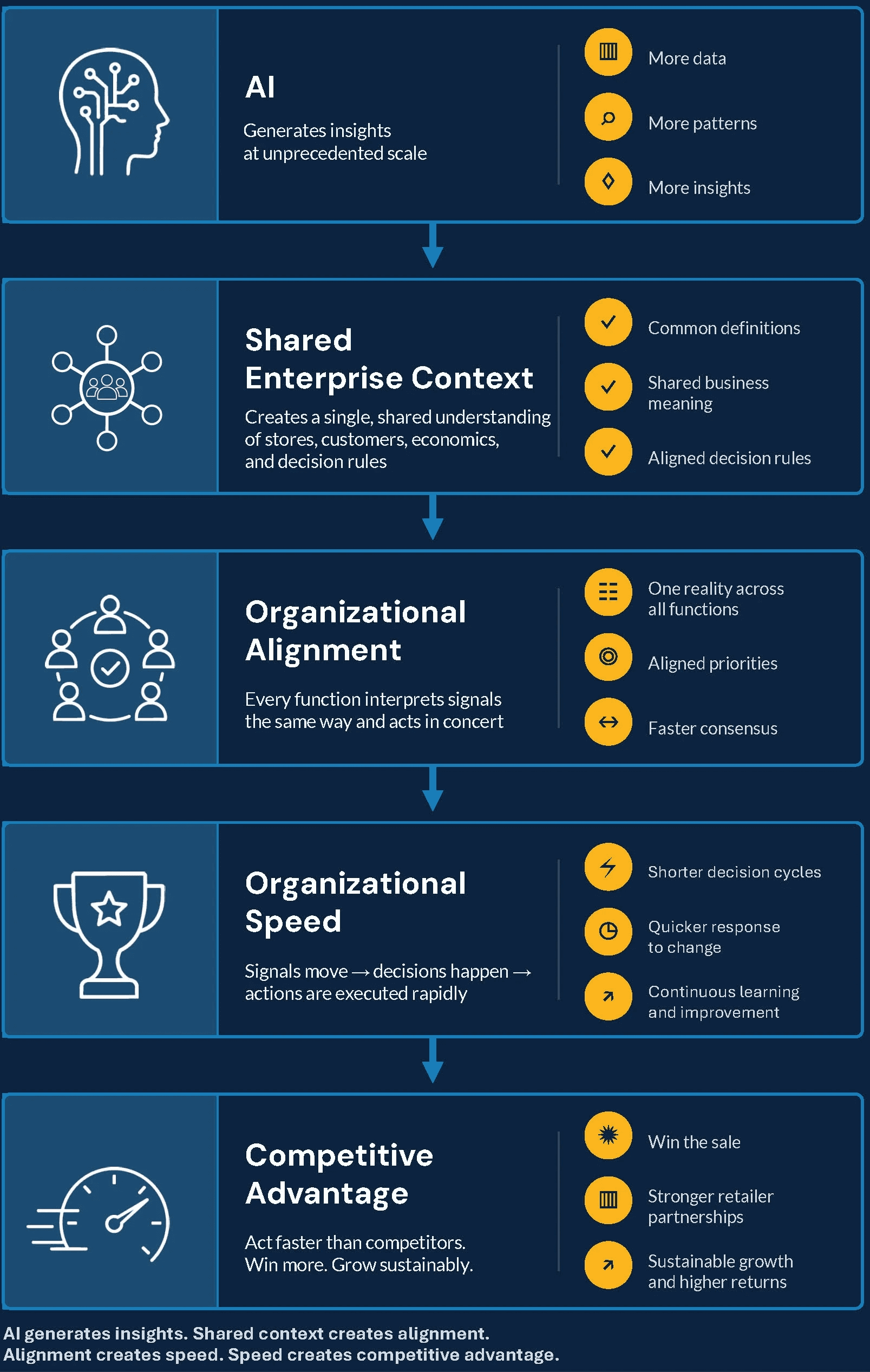
Each phase depends on the previous one. Skip any phase and the entire system breaks.
How the best companies built this
Here's what most executives don't understand about P&G and Walmart: they didn't win through better algorithms or smarter AI.
Metric | Result |
|---|---|
P&G people embedded in Bentonville | 250+ people relocated, a full operating team, not just sales |
Annual sales growth with Walmart | $350 million to $8 billion over 15 years |
On-shelf availability | 98% consistency achieved |
Temperature-sensitive category growth | 30% sales increases sustained |
Shared data infrastructure | CPFR system managing 13 billion daily computations |
P&G-Walmart partnership metrics demonstrating the power of shared operating context
In the early 1990s, P&G relocated 250+ people to Bentonville. Not a sales office. A full operating team embedded in Walmart's systems. P&G dissolved internal divisions. Walmart shared point-of-sale data it withholds from every other supplier. Both companies shared information that made them vulnerable.
What they ultimately created wasn't just closer collaboration; it was a shared interpretation of retail market signals. That's what allowed planning, sales, supply chain, and category management to make decisions based on the same operating assumptions rather than repeatedly negotiating them.
The result: 98% on-shelf availability and 30% sales increases in temperature-sensitive categories that compound year after year.
The pattern extends beyond P&G
Nestlé operates across modern trade and traditional retailers simultaneously. Instead of building separate systems for each channel, Nestlé built a unified way of translating market signals into coordinated action.
Execution Metric | 2025 H1 Performance |
|---|---|
Product-market launches completed | 65 launches across channels |
Sales from new launches | CHF 200 million (USD ~$220-250M) |
Launch coordination model | One operating model, two channels, consistent interpretation |
Nestlé's coordinated execution demonstrates the speed advantage of a unified operating context
One operating model. Two channels. Consistent interpretation across both. That's the pattern: organizations that build shared understanding operate fundamentally faster than those that don't.
What AI is doing
Here's what most executives miss: AI rarely creates organizational problems. It reveals the ones that already existed.
AI faithfully reflects the assumptions embedded in an organization. If different functions operate from different assumptions, AI scales those inconsistencies rather than resolving them. The forecasting model conflicts with demand sensing. The pricing engine conflicts with inventory optimization. The system doesn't work because different parts operate from different definitions of what the data means.
This is why so many AI implementations disappoint. The company automated a problem instead of solving it.
Why does this apply everywhere
In modern trade, chain retailers, e-commerce, and large distributors have data abundance but organizational fragmentation. Functions optimize locally, creating conflicts that slow you down.
In traditional trade, independent retailers and convenience stores have relationship-based decisions that scale poorly. Sales reps know what's working, but that knowledge never becomes enterprise intelligence.
Traditional trade accounts for 40-60% of CPG sales in many markets, especially in emerging economies, yet it operates with minimal digital infrastructure, creating organizational friction between field knowledge and enterprise action.
Both face the same problem: the organization cannot rapidly align around market signals.
What separates winners
Access to AI tools is becoming more widespread. The bigger differentiator is how effectively organizations turn insight into coordinated action.
Most companies focus on connecting systems and data. The real challenge is connecting meaning.
The question that matters
Every CPG executive today is asking the same question: How do we use AI better?
The companies that define the next decade will ask a different one: How do we build an organization that can interpret market signals consistently and act on them before everyone else?
Every AI initiative is actually an organizational design initiative disguised as a technology project. If you're only solving the technology piece, you're automating friction, not eliminating it.
What comes next
In the next decade, the companies that win won't be distinguished by who knows the most. They'll be distinguished by who can align thousands of decisions around the same market reality and execute them before competitors even recognize the opportunity.
Not the companies with the best data. The companies with the fastest decision-making.
The real competition
The next billion dollars spent on AI won't determine who wins. The organizations that translate AI-: generated insights into shared understanding and then into coordinated action will.
The organizations that win won't simply generate more insight. They'll ensure every function understands the same insight the same way.
That's what Shared Operating Context makes possible.
Editor's Note: This framework applies beyond CPG, to banking, healthcare, manufacturing, and any large organization where speed of organizational decision-making determines competitive advantage. The question executives should ask is not about AI capability. It's about organizational design: Can your enterprise consistently interpret market signals to capture first-mover advantage?