Every new AI initiative seems to start with the same question: "Can we make this agentic?"
In many cases, that's the wrong question.
The better question is: "What is the simplest architecture that reliably solves the problem?"
Right now, every workflow is being redesigned as an agent.
Route a request? Agent.
Read an email and trigger an action? Agent.
Summarize, classify, validate, and update a system? Agent.
The excitement is fair; agentic AI is powerful. But many teams are making one basic mistake: they reach for agents even when the workflow is already deterministic, sequential, and fully known.
That isn’t innovation. It’s avoidable complexity.
The design mistake
If a process already has a clear path, why ask an LLM to plan it?
If the next step is known, why make an agent decide it?
If rules, libraries, or code can do the job, why insert non-deterministic reasoning in the middle?
A system should not be designed this way.
What deterministic really means
A deterministic workflow has a known sequence, defined logic, stable rules, and repeatable output. Same input, same output. It’s exactly what most enterprise workflows need.
For example:
Validate a form and route it.
Check policy conditions and approve or reject.
Extract structured fields and push them downstream.
Enrich a ticket from known systems, or reconcile and transform data.
These are not planning problems. They are execution problems.
Where teams go wrong
The temptation is to hand the whole workflow to the LLM: deciding what the user means, which tool to call, what to do next, whether to continue, and when it’s done. It looks intelligent. But when the flow is already known, you’ve turned a predictable sequence into a probabilistic controller that is harder to test, more expensive to run, and less governable. You’re asking a model to make choices the architecture already knows.
The better principle
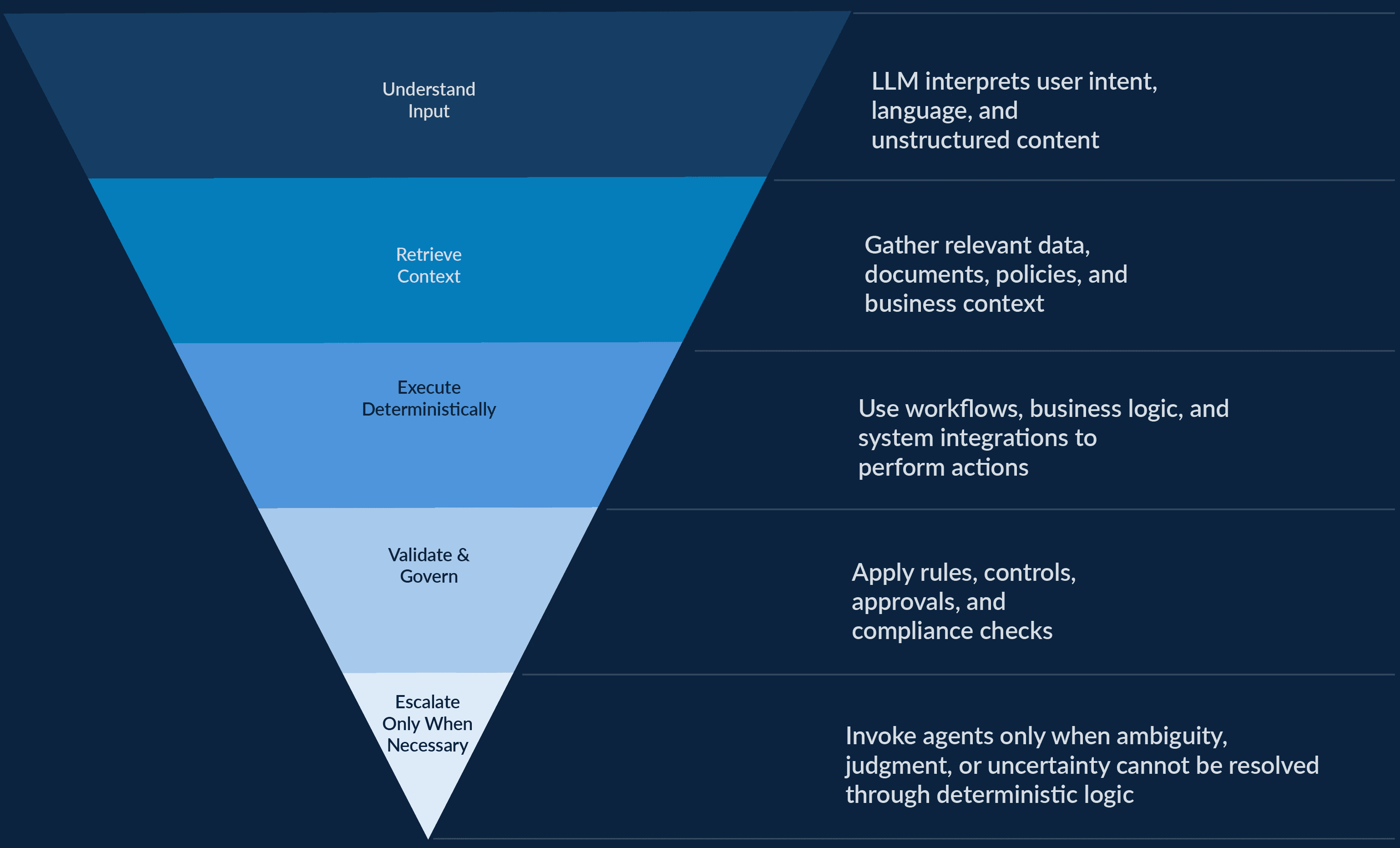
The most effective AI systems let AI handle interpretation while keeping workflow execution predictable and controlled.
Separate understanding from execution
Use an LLM to interpret messy language.
Use retrieval to find the right context.
Use code, rules, and workflows to execute the next known step.
Keep language understanding probabilistic while execution deterministic wherever possible.
Why deterministic should be the default
Lower cost. Every planning step, tool decision, retry loop, and reflection cycle adds tokens, latency, and infrastructure. Rediscovering a step the system already knows is redundant.
Better reliability. Deterministic design gives repeatable outcomes, easier testing, cleaner debugging, and stronger auditability. When a process affects customers, money, or compliance, predictability is a requirement; not a nice-to-have.
Faster ROI. Deterministic systems reach production faster, requiring less tuning and orchestration. A simpler system offering 90% of the value usually outweighs an autonomous one with 10x the complexity.
Easier governance. Rule- and workflow-driven systems are easier for engineering, risk, and operations to understand. Explicit decisions mean clear ownership. Delegated decisions weaken explanations and raise support overhead.
More sustainable AI. If a library, function, or rules engine can solve it, a large agentic loop is unnecessary compute. Sustainable AI isn’t just about greener infrastructure; it’s choosing the least expensive intelligence that can accomplish the task.
Where agents do help
Autonomy earns its cost when the path is not known in advance, like in the case of ambiguity, dynamic planning, multiple possible next steps, changing context, open-ended execution, uncertain tool selection. But when the workflow already has a defined sequence, agentic control becomes architectural overreach.
The hidden cost of “let the agent decide”
More failure modes, more monitoring, more evaluation.
More latency and exception handling.
More prompt and tool management.
More effort to regain user trust when behavior drifts.
The decision matrix: agent or not?
Here’s a go-to decision framework to help with an initial assessment before designing a solution.
How does it work?
Score a workflow across the given factors.
If most answers fall in the middle column, codify it.
If they cluster on the right, an agent earns its cost.
For mixed scenarios, keep execution deterministic and escalate only the uncertain step to an agent.
| Decision factor | Go deterministic (rules / code / workflow) | Go agentic (LLM plans & acts) |
|---|---|---|
| Path / sequence | Known and fixed in advance | Unknown and discovered at runtime |
| Logic & rules | Stable, well-defined, documented | Ambiguous, evolving, open-ended |
| Output expectation | Repeatable: same input, same output | Variable: multiple valid outcomes |
| Number of next steps | One obvious next step | Multiple plausible paths |
| Tool selection | Predetermined tools | Dynamic tool selection required |
| Risk / compliance | Strict audit trail and regulatory guarantees required | Guardrails, controls, and human judgment required for high-stakes scenarios |
| Testing & debugging | Behavior must be fully testable and predictable | Behavior requires evaluation, tracing, and observability |
| Cost sensitivity | Cost and latency must remain tightly bounded | Additional cost and latency justified by task complexity |
| Example | Validate a form, route a ticket, reconcile data | Investigate an incident, resolve an ambiguous request, conduct research |
Rule of thumb: The more boxes you tick on the left, the stronger the case against autonomy. One genuinely uncertain factor doesn’t justify making the whole workflow agentic; instead, isolate it.
A better architecture pattern
The question leaders should ask
Not “Can we make this agentic?” but “What is the simplest architecture that solves this problem well?” If a deterministic sequence can achieve the outcome, having an agent plan each step isn’t sophistication, it’s added cost and complexity without added value.
Bottom line
Use LLMs where judgment is needed. Use deterministic systems where certainty is already available. That’s not being conservative; that’s good engineering.