Consumer Insights was designed for a world where decisions happened quarterly. The business now makes them weekly, often daily. And underneath that sits a harder truth: consumers now change preferences faster than organizations change decisions.
This lesson is one most brand leaders learn the hard way. Years ago, a brand manager asked a simple question: why was the brand losing share among Millennial men? Two weeks later, the insights team delivered a rigorous 40-slide review and proposed another six weeks of research. The issue had been visible for nearly two years, and the organization was still studying it rather than acting on it.
It's tempting to treat the insights team as the bottleneck. That thinking is wrong. The people were excellent. The operating model was the problem.

The competitive shift: From knowing to learning
Advantage in consumer goods is shifting from who knows the most to who learns the fastest. The way to manage that shift is to measure it.
Call it decision latency: the time between a consumer signal and the executive decision it should inform.
Decision latency isn't a Consumer Insights metric. It's an organizational learning metric. It tells you how quickly your company converts what the market is saying into what the company does.
Decision latency is not research cycle time. It is not dashboard refresh rate. It is the span from market signal to board-table action.
Why the old model broke
Three forces have made quarterly insights obsolete, and none of them reverses.
First, every meaningful question now spans five or more sources: POS, panel, media, reviews, social, and years of qualitative research. The insight lives in the synthesis, which by hand is brutally slow. A pricing question touches revenue management, sales, supply chain, and finance. A retailer negotiation requires current share, projected volume, margin impact, and category trends in one document. These syntheses used to take weeks.
Second, the signals never stop, while the instruments age before anyone opens them. Monthly dashboards become stale before distribution. Quarterly trackers reflect decisions already made. Meanwhile, insights teams stay flat while signal volume compounds exponentially. For a decade, the industry's answer was more dashboards, even though dashboard count and decision quality are essentially uncorrelated.
Third, companies don't lose because they lack insight. They lose because insight arrives after the decision has already been made.
The cost is real but never booked
A pricing response delayed by three weeks of analysis. An innovation window missed because the synthesis wasn't ready. A retailer negotiation walked into with stale evidence. No company records 'decided late' as a line item, yet summed across a portfolio and a year, it is a high hidden cost.
Nestlé has publicly reported that its internal AI assistant, NesGPT, helped compress early-stage product ideation from roughly six months to six weeks, an early glimpse of what happens when organizational knowledge becomes instantly accessible rather than archived.
To uncover these costs, organizations should ask one question at the next leadership meeting: When did a new consumer signal last materially change a decision here, and how long did it take?
Why low latency creates durable advantage
Consumer understanding only becomes competitive advantage when it changes a decision faster than the competition.
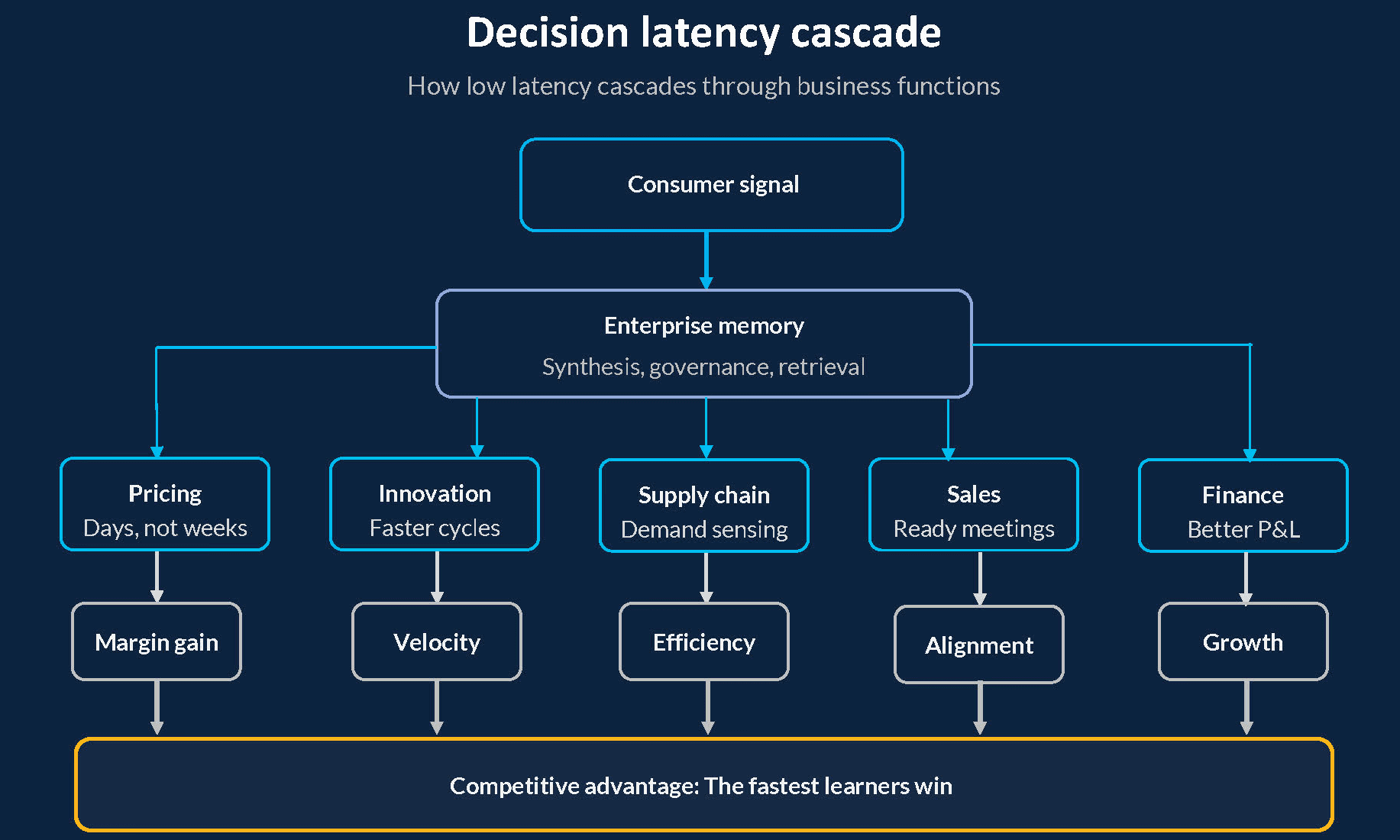
The mechanism is concrete. Lower decision latency means earlier pricing adjustments, faster innovation cycles, quicker responses to retailer moves, better capital allocation, less duplicated research, and faster alignment. Each is a familiar lever; latency is what they have in common.
Two structural facts make this the battleground.
First, every function now depends on consumer understanding, revenue management, supply chain, innovation, sales, and finance. Consumer understanding stops being a department's output and becomes enterprise infrastructure. Unlike a ledger, it is probabilistic and continuously evolving, but it increasingly needs the same enterprise qualities: accessibility, governance, lineage, and trust.
Second, the technology will not differentiate anyone for long. Every company will soon have access to essentially the same foundation models. Two companies with identical models and identical data will perform differently on operating model alone. The durable advantage is organizational.
What low latency looks like: A Monday morning
Across industries, one pattern is emerging: knowledge businesses are becoming memory businesses.
Morgan Stanley put a GPT-4 assistant over its research library so any advisor can query decades of institutional knowledge in plain language. By the firm's own account, over 98% of advisor teams use it, with humans approving what reaches clients.
Consumer goods companies hold exactly that kind of asset. Most just store it where no one can reach it.
In CPG, low latency looks like this:
A Monday morning. The brand manager asks why the brand is softening in convenience. The sales director needs a story to walk into tomorrow's buyer meeting. No briefs. No queue. Both questions flow into one governed memory of everything the company knows about its consumers. Because it is one memory, the answers come back connected, sources and confidence attached, reviewed by a human before anything ships.
This is the point: one enterprise memory, answering multiple decisions simultaneously. Weeks of latency, gone.
Four capabilities that make it possible
Enterprise memory
Capture and retrieve organizational learning. Ask 'what have we learned about indulgence among Millennials over seven years?' and receive one answer: themes, contradictions, what changed, the gaps worth new spend. Memory cuts latency by eliminating rediscovery. Budgets stop re-buying knowledge the company already owns.
Enterprise reasoning
Stress-test every strategic decision. Before a launch call, two AI agents build the strongest opposing cases, evidence attached to both. This fixes an organizational flaw, not a technical one: the case against the preferred option is chronically under-produced because no career advances by arguing the downside brilliantly. Machine-generated dissent carries no career risk. Reasoning cuts latency by collapsing alignment time.
Enterprise simulation
Rehearse before committing capital. A price move is tested against retailer reaction, consumer switching, media impact, and category effect before real money meets the market. These simulations won't predict perfectly; their value is making assumptions explicit, testing ranges of outcomes, and showing where a decision is most fragile. Simulation cuts latency by replacing market learning with pre-market learning.
Intelligence stewardship
Govern how the memory evolves. If last year's research says convenience matters most, but six months of behavioral data now shows value has become the dominant driver, who decides the old conclusion has been superseded? Someone must curate what becomes organizational truth. This is the insights profession's genuinely new craft, closer to editing a living body of knowledge than producing studies. It is what keeps latency low permanently, because a curated memory means every decision teaches the next one.

One boundary makes all four trustworthy
Let AI assemble the evidence. Let humans exercise judgment. Keep accountability with the organization.
The deployments that work are built exactly this way: reasoning visible enough to inspect, and human gates through which nothing ships unreviewed. In practice, a slightly less accurate system with visible reasoning can outperform a more accurate black box organizationally, not technically, because people are willing to use and challenge it. Hallucination, governance, and privacy aren't reasons to avoid AI; they're design constraints.
How to locate your company on this curve
Organizations should ask these four questions at the next leadership meeting:
How long did it take the last time a new consumer signal materially changed a pricing, innovation, or customer decision?
Which important decisions still depend on someone assembling evidence by hand?
How much of everything the company has learned about its consumers can the people deciding today actually reach?
How much of the organization's consumer understanding is institutionalized versus residing in individual people?
The gap between an organization's answers and its competitors' answers is measurable. It's also shrinking.
The redefinition of Consumer Insights
All this recasts a function and a role. The head of Consumer Insights may soon steward the organization's most valuable strategic asset: not research, but organizational learning.
For decades, Consumer Insights helped companies understand the market.
Its next mandate may be larger: helping the entire enterprise learn faster than its competitors.
Whether the function keeps its name matters far less than whether it takes up that mandate.
One warning from those who have gone first: treat this as IT procurement, and you'll get a tool. Treat it as an operating-model decision, and you'll get a capability. The model shifts three ways from episodic research to continuously updated memory; from delivering findings to changing decisions; from serving one function to powering shared enterprise learning.