Codex has moved coding tools from autocomplete to action. It can explain unfamiliar code, propose changes, run commands, generate tests, and work through substantial engineering tasks at a speed that was difficult to imagine even a year ago.
That power is precisely why enterprises need a clearer operating model. Codex can write code. The question is whether teams can use it in production codebases without weakening maintainability, reviewability, architectural consistency, or release quality.
In our view, most market messaging still leans too heavily toward full autonomy. The common picture is simple: assign a task, let the agent work, review the final pull request, and move on. That can be impressive in a demo. In enterprise delivery, it is usually the wrong mental model.
Most enterprise engineering work is not greenfield. It is change within systems that already matter like legacy services, governed data pipelines, model training jobs, regulated workflows, cost-sensitive cloud environments, and codebases that must remain understandable later. In that world, acceleration is valuable only when it remains controlled.
Fractal's position is straightforward: Codex is an accelerator. It accelerates good engineering, but it can just as easily accelerate bad engineering. If organizations hand coding agents to teams or partners without a disciplined framework, the result is not faster delivery. It is faster drift.
This distinction matters because the chokepoint in badly governed agentic development is not coding speed; it is review debt. When the agent makes too many micro-decisions on its own, diffs become bloated, redundant abstractions multiply, and lead engineers become bottlenecks, pushing more review and maintenance effort downstream.
Why enterprises need a different model
The difference between "vibe coding" and enterprise delivery is not intelligence; it is accountability.
Vibe coding assumes the primary objective is getting something to work. Enterprise delivery demands more: predictable behavior, minimal change surface, architectural fit, operational traceability, and confident rollback.
That is why the engineer using Codex must increasingly think like an architect. Before asking the tool to act, the engineer should be able to answer five questions: What is the current state? What is the target end state? What must not change? What evidence will prove the step worked? What is the smallest safe unit of change?
When these answers exist, Codex becomes a powerful pair programmer. When they do not, Codex fills the vacuum with plausible but ungoverned decisions.
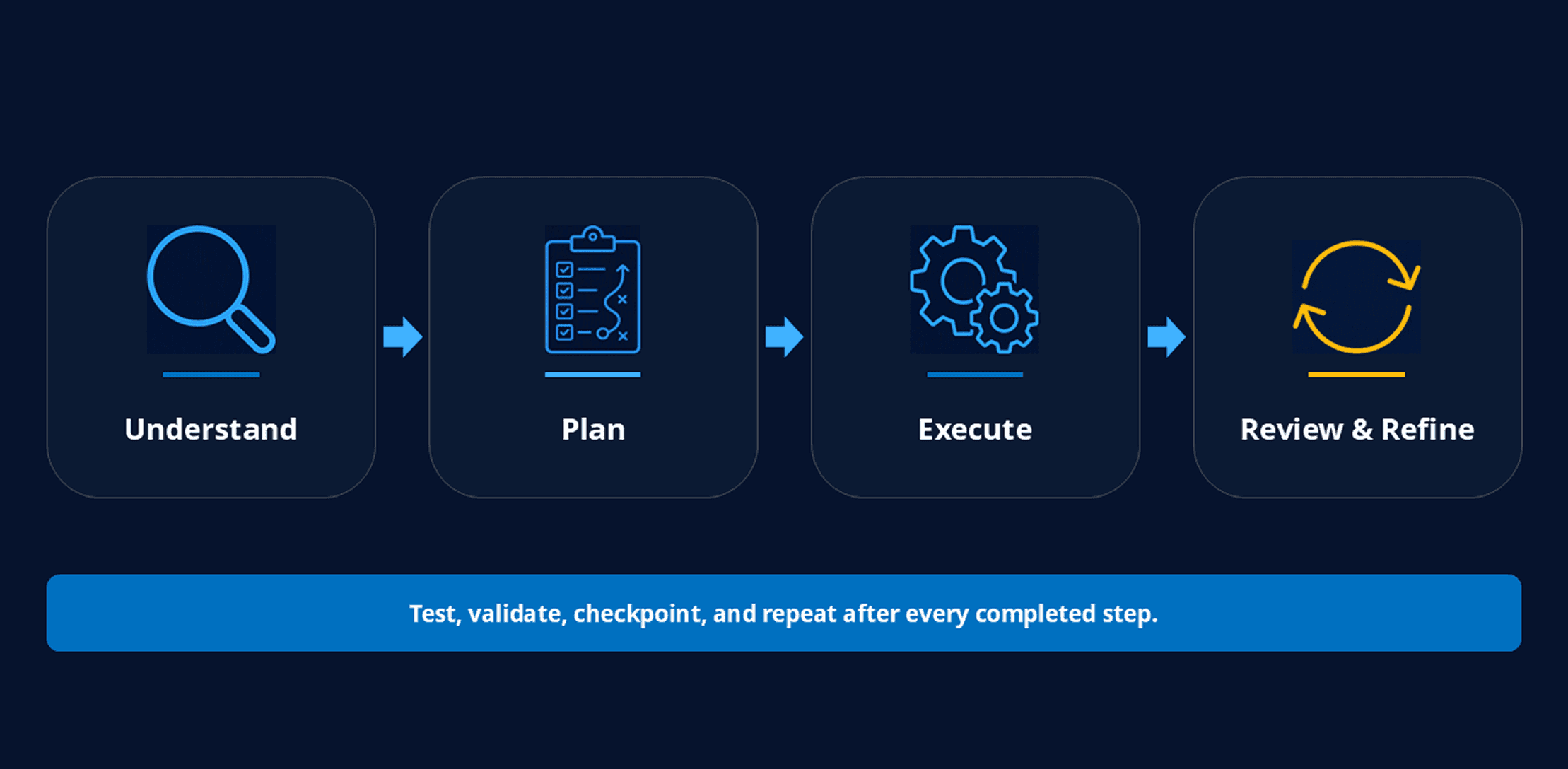
While the framework is intentionally simple, its effectiveness comes from the loop. The team first builds understanding, then converts that understanding into a controlled plan, then asks Codex to implement only the next bounded step, and finally closes the loop through review, validation, and refinement.
This is the practical difference between using Codex as a one-shot code generator and using it as part of a serious engineering system.
Step 0: Establish the engineering operating system first
Before the four-step loop begins, the environment itself must be set up correctly. This is where many teams lose control before the first prompt is even written.
At minimum, the repository should have a sane architecture, clear folder structure, defined coding standards, build and test commands, and durable project guidance that Codex can reuse. For greenfield work or major restructuring, teams can also use Codex plan mode against the BRD or PRD to iterate on architecture, tool stack, and folder structure before implementation begins. In Codex, that usually means capturing recurring rules in AGENTS.md, keeping project-specific configuration explicit, and choosing approval and sandbox settings deliberately rather than implicitly.
Just as importantly, teams should create Git checkpoints before and after meaningful tasks. If a step turns out to be wrong, rollback should be easy, obvious, and fast.
This setup work is not overhead. It is the control plane that allows Codex to accelerate delivery without turning the codebase into a moving target.
Notably, this philosophy is consistent with OpenAI's current Codex guidance: treat Codex like a teammate with explicit context and a clear definition of done; keep reusable instructions in AGENTS.md; and bracket meaningful tasks with Git checkpoints.
Understand: Build the mental model before you touch the code
This is the most commonly skipped step, and it is the reason many agent-driven changes feel impressive at first and brittle later.
Understanding means more than reading a file. It means understanding the business objective of the module, the architecture around it, upstream and downstream dependencies, expected inputs and outputs, performance constraints, and what ‘correct’ actually means.
Codex can and should accelerate this stage. Ask it to explain the flow of a module, summarize dependencies, trace how a field is produced, or compare two implementations. Use it as a Q&A partner. But do not outsource the thinking itself. The engineer still needs to create a mental map of what is being changed.
A useful practice is to create a short understanding artifact in markdown before implementation begins. That note might capture the purpose of the module, key data contracts or formulas, known failure points, and what must remain unchanged after the edit. That artifact becomes the grounding layer for every later prompt.
Plan: Define current state, target state, and validation steps
Once the engineer understands the problem, the next task is to turn that understanding into a change plan.
The plan should describe the current state, the target end state, and the sequence of steps required to move from one to the other. The most important design rule is that each step should leave the solution in a runnable state and should have a clear validation method.
This changes the interaction with Codex completely. Instead of saying "refactor this pipeline" or "optimize this module", the engineer can say, "here is the current state, here is the approved target state, here is the plan, implement Step 2 only."
That discipline narrows the change surface, improves reviewability, and makes it easy to resume in a fresh session without losing context. In practice, the plan itself can be drafted by Codex. But it should always be reviewed and refined by the engineer before execution begins.
Execute: Ask Codex to perform only the next bounded step
In a governed workflow, execution is where Codex does the most visible work. It is also where discipline matters most. But in practice, the engineer now spends disproportionate time in Understand and Plan; execution and review become short, repeated steering loops in which the tool does most of the writing while the engineer keeps the change aligned to architecture, constraints, and test evidence.
The prompt for execution should always carry forward the approved plan, identify which steps are already complete, and specify the next step to implement. The engineer should constrain the agent tightly: make minimal changes, preserve output schema and business logic where required, avoid unnecessary abstractions, and keep temporary diagnostics isolated.
This is especially important for refactoring, bug fixes, performance optimization, and mismatch diagnosis. In those cases, the goal is often not to invent new logic but to preserve existing behavior while changing structure, speed, or reliability. For refactoring and validation-heavy work, teams should compare the original and updated paths against the same inputs and use temporary diagnostic logs to verify parity at intermediate checkpoints, not just at the final output.
Minimal enterprise prompt package
Relevant file or module, not the entire repo by default
Current state and target end state
Approved stepwise plan
Non-negotiable constraints and invariants
Validation command, test, or expected output contract
Reference implementation, logs, or errors when applicable
If execution happens on a remote platform such as Databricks or Airflow, bring back the exact logs and error output as artifacts for the next prompt.
Review & Refine: Use fresh perspective before you move on
This is where enterprise quality is actually protected.
After Codex completes a step, the engineer should review the diff manually and ask whether the changes align with the intended approach. If gaps exist, ask for incremental corrections rather than another broad rewrite.
A particularly effective practice is to open a fresh Codex session and use it as a reviewer. Provide the plan, the version of the code before the step or a reference version when relevant, and any diagnostic logs or parity evidence generated during execution. Then explain that a specific step has just been completed and ask the new session to identify anything that was missed, changed accidentally, or implemented beyond scope. Repeating this with two or three fresh reviews often surfaces issues that the original working thread normalized.
A step is not complete until it passes three gates: manual review of the changes, validation or test execution, and a clean checkpoint or commit before the next step. This is what prevents fast local wins from accumulating hidden inconsistencies across the codebase. Teams should also treat the plan as a living artifact: if execution reveals a better sequence, a hidden dependency, or a missing validation step, the plan should be updated before work continues.
To make this operating model easier to apply, the next section provides concise prompt patterns for the most common engineering tasks.
Few concise prompt patterns that work
Prompt type | Example prompt |
Understand |
|
Plan |
|
Execute |
|
Review |
|
Evidence-rich debugging: why logs change the quality of Codex output
One of the most useful patterns in our work has been giving Codex more than the code. When debugging, resolving mismatches, or analyzing performance, the highest-quality responses often come when the model receives a compact evidence pack: the exact code block under review, the observed log output, the error trace, the current objective, and the invariant that must be preserved.
This is especially valuable when execution happens outside the developer laptop. If the code runs in Databricks, Spark, Airflow, or another managed environment, Codex cannot infer what happened from the code alone. The logs are the missing half of the story.
A prompt like this is materially stronger than a generic request such as "my pipeline is failing, please fix it." It grounds Codex in observed execution evidence, reduces unnecessary speculation, and keeps the response bounded to a traceable, minimal fix. For refactoring, performance optimization, or mismatch diagnosis, the same pattern becomes even stronger when the engineer also brings back comparable logs or intermediate diagnostics from the reference or unrefactored path, so Codex can reason about parity rather than infer it.
The tags used inside "/output_and_error.txt" - such as <code_block_under_review>, <print_logs_and_outputs>, and <error_observed> - are simply developer-defined separators. They do not need to follow any fixed template; they only need to make the evidence pack clear and easy for the model to parse.
How the framework applies across the SDLC
New feature development: Understand the current solution, the business value of the new capability, and the impacted modules before asking Codex to implement the change step by step.
Refactoring: Keep an unrefactored reference path available, preserve output parity, and add temporary diagnostics only in isolated helpers or wrappers so they can be removed cleanly later without touching the core logic.
Performance optimization: Separate runtime improvements from logic changes and validate both speed and output parity after each checkpoint.
Bug resolution: Trace the failure to a specific module, attach the real logs and stack traces, and ask for minimal fixes rather than broad redesign.
Mismatch or validation investigation: Compare expected versus actual outputs with evidence, isolate where the contract breaks, and avoid making broad corrective changes before the source is understood.
Test creation: Understand the business behavior first, then use Codex to scaffold cases, fixtures, and edge-condition coverage.
Documentation, upgrades, and migration work: Plan the rollout in safe increments, keep the system runnable, and review every step against the intended architecture.
Common failure modes to avoid
Delegating full SDLC ownership to the agent and hoping review will catch everything later
Skipping understanding because the model can read the code faster than a human
Asking for end-to-end repo rewrites instead of incremental, testable steps
Accepting diffs that create new helpers, abstractions, or architectural drift without justification
Reviewing only at PR time instead of after each bounded step
Running parallel agent threads on the same files or modules
Forgetting to externalize durable project guidance in AGENTS.md or equivalent repo context
Skipping Git checkpoints before meaningful changes
What this means for enterprises
This framework helps teams convert raw agent speed into dependable delivery, without slowing Codex down.
Organizations that benefit most from Codex are likely to be those that create a governed operating model around architecture, prompts, checkpoints, review, and validation, rather than simply maximizing autonomy at the start.
That is where Fractal differentiates itself from implementation partners that use coding agents as generic output engines. The value extends beyond access to the tool. It lies in a disciplined method for turning the tool into enterprise-grade delivery capability.
Conclusion: Governed acceleration wins
Codex can compress engineering effort dramatically. But it does not remove the need for thinking, architecture, or review. In fact, it raises the premium on all three.
The practical model is clear: Let Codex write faster. Let the engineer think sharper. Keep the workflow stepwise, observable, and testable. Use durable repo guidance. Carry forward the plan. Review from fresh context. Validate before committing. Repeat.
This is how teams move from one-shot demos to production-grade outcomes.
The winning enterprise pattern is not autonomous coding. It is governed acceleration: human judgment sets the direction, Codex compresses the effort, and validation closes the loop.
Beyond the question of whether teams have access to Codex, enterprises must assess whether teams and partners have a governed method for using it well. That is the standard Fractal believes should define AI-enabled engineering.
Need help? Contact us.
If your enterprise is evaluating Codex or similar coding agents, the fastest path to durable value is to put the operating model in place before scaling adoption. Fractal can help define the governance, prompting patterns, repo guidance, review checkpoints, and validation workflow needed to turn coding agents into a controlled engineering accelerator.
A short working session can map your current SDLC to this framework, identify risk points, and define what high-quality, traceable AI-enabled delivery should look like for your teams and implementation partners.