Agentic diagram parsing: Turning visual logic into enterprise intelligence
By Harsh Saxena and Prateek Dhawalia
Modern enterprises run on visual artifacts, flowcharts, SOP diagrams, customer-journey maps, escalation flows, and process schematics. These diagrams hold critical operational logic yet remain largely invisible to automation systems.
A new AI capability is changing this: agentic diagram parsing, which transforms static diagrams into machine-readable, executable process graphs. This shift unlocks faster automation, deeper process intelligence, and more adaptive enterprise operations.
Enterprises today face five core barriers:
Fragmented formats: Diagrams arrive as PDFs, screenshots, slides, scans, and images, often low quality and inconsistent.
Manual translation: Analysts spend hours converting diagrams into workflows, introducing delays and risk.
Disconnected logic: Even when shapes are detected, mapping them to enterprise rules and systems is difficult.
Poor integration: Parsed outputs rarely align cleanly with CRM, orchestration, or planning platforms.
Low adaptability: Adding new diagram types or rules demands major rework.
The solution
Agentic diagram parsing delivers a unified, extensible approach:
Automated diagram understanding: Computer vision, connected components, OCR, and vision-language models extract shapes, connectors, labels, and annotations across any diagram style.
Semantic grounding: Parsed elements are mapped directly into workflows, taxonomies, and domain rules.
Seamless integration: Outputs align with CRM, ticketing, orchestration, and planning systems, enabling end-to-end automation.
Intelligent insights: An inference layer highlights process gaps, inefficiencies, and optimization opportunities.
Modular architecture: New diagram types, business rules, or ML capabilities can be added with minimal friction.
Why diagram understanding is hard
Enterprise diagrams resist automation because they are:
Heterogeneous: Formats, quality, and fidelity vary widely.
Ambiguous: Teams use different symbols, labels, and connector styles.
Inconsistent: Arrowheads, conditions, and labels may be missing or placed unpredictably.
Semantically complex: Extracted shapes must map to real approvals, validations, handoffs, and escalations.
Massive in scale: Large organizations maintain thousands of diagrams across teams and systems.
These realities make diagram intelligence one of the next major frontiers in enterprise AI.
Why this matters
Visual processes are the backbone of enterprise design and governance. Making them machine-readable unlocks:
Agentic workflow execution: AI agents can run business logic directly from diagrams.
Process-aware automation: Approvals, exceptions, dependencies, and routing logic become visible to downstream systems.
Cross-process optimization: Patterns across teams can be standardized and automated.
Faster customer and partner onboarding: Client diagrams, approval matrices, and requirement maps become instantly actionable.
Stronger compliance and auditability: Compare “as-designed” vs. “as-executed” processes automatically.
This is foundational for multimodal enterprise agents that understand not only text and data, but visual logic.
What this really transforms
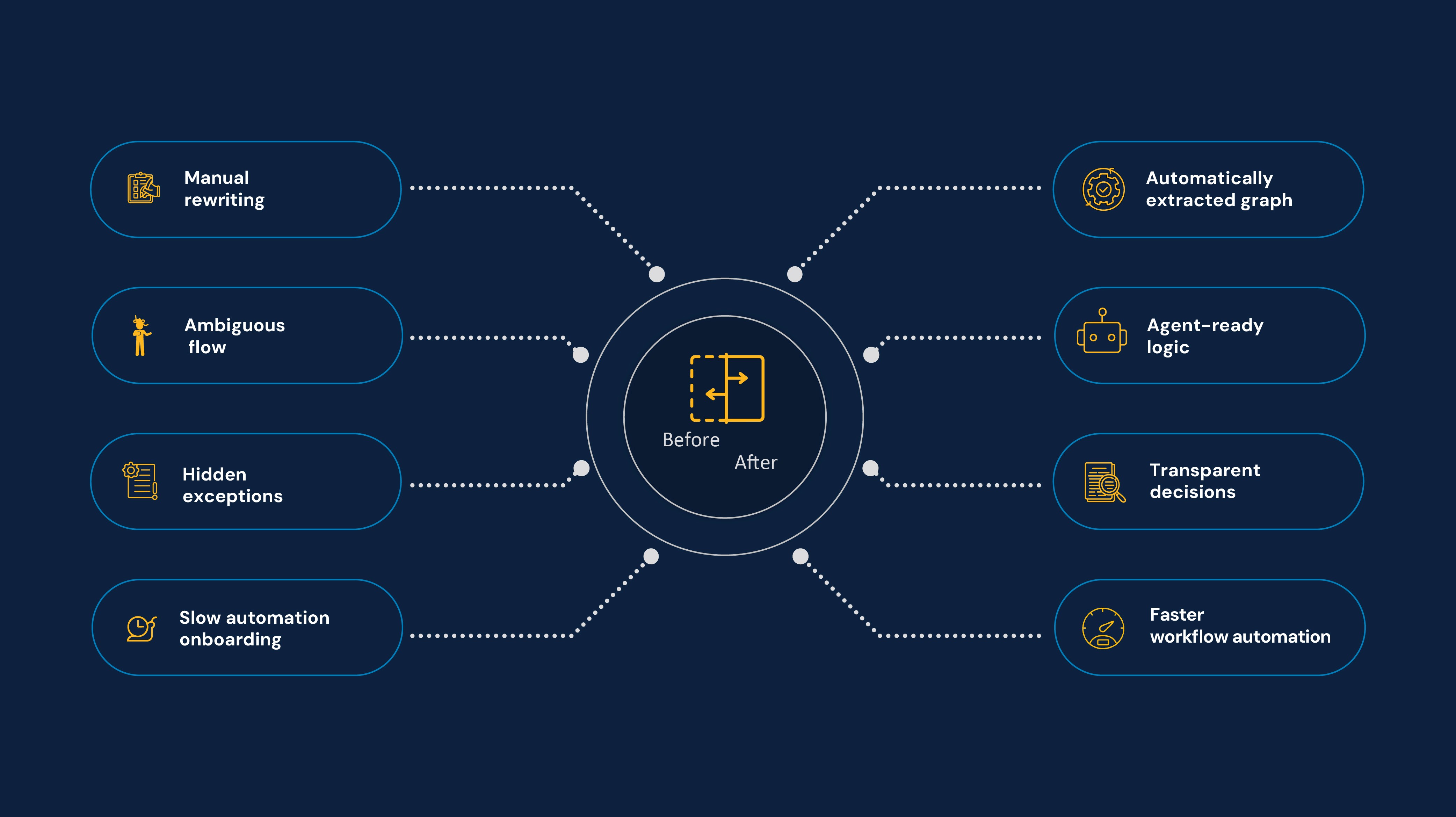
Traditionally, organizations invest significant manual effort deciphering flowcharts and rebuilding them as workflows. Exceptions hide in diagrams, and automation depends on human translation.
Agentic diagram parsing eliminates that bottleneck. Visual flows become machine-readable graphs ready for execution and optimization. Logic becomes transparent, decisions traceable, and workflows instantly operational.
What once took hours now takes seconds.
The vision forward
As enterprises embrace agentic architectures, the constraint isn’t AI capability—it’s structured context. Much of that context lives in diagrams.
By converting diagrams into actionable process intelligence, organizations move closer to a frictionless future:
Upload a diagram → Receive an executable workflow.
This convergence of diagram understanding, semantic reasoning, and agentic orchestration signals a major evolution in enterprise AI—where processes are not just documented, but interpreted, operationalized, and continuously optimized.
Recent Blogs