The five methods of hybrid search for Enterprise AI systems
Each method below is documented across four dimensions: what it is, why it exists, the common issues that arise in practice, and the practical pattern for deploying it effectively in an enterprise environment.
Why hybrid? The precision–recall problem
Enterprise search systems operate under constraints consumer search engines seldom encounter: inconsistent terminology across departments, legacy and current documentation side by side, mixed structured and unstructured formats, low-context user queries, and strict governance requirements. Traditional keyword search forces a choice between precision (exact matches only) and recall (broad coverage). No single method resolves this trade-off, which is why the five methods below are designed to work together.
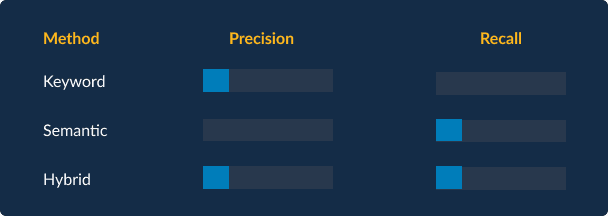
The bars above illustrate the trade-off each method makes on its own. Hybrid search, with RRF fusion, approaches strong performance on both axes simultaneously.
How the five methods connect
Methods 01–04 are retrieval strategies. Method 05 (RRF) is the fusion layer that combines their ranked outputs into a single, stable result set. In a production hybrid stack, all three retrieval methods run in parallel; RRF then merges their ranked lists before serving results.
Method 01 - Precision Full-text queries | |
|---|---|
What it is | Full-text queries are structured search instructions that give users explicit control over how information is retrieved. They support Boolean logic (AND, OR, NOT), phrase matching, field targeting (e.g., search only in titles or metadata), and rule-based constraints, going far beyond a simple keyword lookup. |
Why it exists | Enterprise workflows often require exact, traceable answers. A compliance officer looking for a specific policy revision, a legal team running discovery, or an engineer hunting a precise error code cannot afford semantic drift. Full-text queries ensure that retrieval is deterministic, auditable, and governable; qualities that semantic systems alone cannot guarantee. |
Common issues |
|
Practical pattern | Use full-text queries as the primary retrieval mode for compliance, audit, and legal workflows where traceability is mandatory. Abstract the syntax behind guided filter interfaces (dropdowns, date pickers, field selectors), so non-technical users can build precise queries without writing Boolean expressions. Layer fuzzy or semantic retrieval as a fallback for exploratory searches. |
Method 02 - Precision BM25 | |
|---|---|
What it is | BM25 (Best Match 25) is a probabilistic ranking function that scores documents by evaluating two signals: term frequency (how often a query term appears in a document) and inverse document frequency (how rare that term is across the entire corpus). It also applies a document length normalization so that longer documents do not unfairly dominate rankings simply by containing more words. |
Why it exists | Not all keyword matches are equal. A document that uses a rare, discriminative term once is often more relevant than one that repeats a common term dozens of times. BM25 captures this intuition algorithmically, making it far more effective than raw keyword counting for technical documentation, product references, incident reports, and policy lookups where terminology is precise and distinctive. |
Common issues |
|
Practical pattern | Deploy BM25 as the default lexical ranking layer for all keyword-driven searches. Tune the k1 (term frequency saturation) and b (length normalization) parameters to your corpus; technical corpora with short, dense documents typically need lower b values. Feed BM25 results into RRF alongside semantic results rather than serving them directly, so lexical precision combines with semantic recall. |
Method 03 - Recall Fuzzy matching | |
|---|---|
What it is | Fuzzy matching retrieves results despite minor differences between the query and indexed content. It uses edit-distance algorithms (such as Levenshtein distance) to find terms within a defined number of character edits; insertions, deletions, or substitutions of the query term. A fuzziness of 1 means one character change is tolerated; a fuzziness of 2 tolerates two. |
Why it exists | Enterprise users search under time pressure, from mobile devices, in second languages, or using informal shorthand. Vendor names get misspelled, ticket numbers get transposed, and product codes get abbreviated. Without fuzzy matching, these searches silently fail, and users assume the information does not exist, when it does. Fuzzy matching closes the gap between imperfect input and successful retrieval. |
Common issues |
|
Practical pattern | Apply fuzzy matching selectively rather than globally. Use it as a fallback triggered only when an exact or BM25 query returns zero or very few results. For autocomplete and typeahead, apply fuzziness of 1 on tokens under 6 characters and fuzziness of 2 on longer tokens. Suppress fuzzy matching on numeric fields (ticket IDs, version numbers) where near matches are genuinely meaningless. |
Method 04 - Recall Vector embeddings | |
|---|---|
What it is | Vector embeddings are dense numerical representations of text produced by machine learning models. Each piece of text, a query, a sentence, a document chunk, is encoded as a point in a high-dimensional vector space where semantic similarity corresponds to geometric proximity. Retrieval works by finding stored vectors nearest to the query vector, typically using approximate nearest neighbor (ANN) search. |
Why it exists | Users often do not know the exact wording of the document they need. A new employee searching 'how do I submit expenses' should find the finance team's reimbursement policy, even if it never uses the word 'submit'. Embedding-based retrieval bridges vocabulary gaps, supports natural language queries, and enables discovery across synonym-rich domains, making it essential for conversational search interfaces and cross-functional knowledge bases. |
Common issues |
|
Practical pattern | Embed document chunks at ingestion time using a model appropriate for your domain. Chunk by semantic units (paragraphs or sections) rather than fixed character counts. At query time, generate the query embedding with the same model and retrieve the top-k nearest neighbors. Always re-rank results using RRF or a cross-encoder before serving, and enforce access-control filtering after retrieval, never before, as pre-filtering on embeddings can silently exclude relevant results. |
Method 05 - Fusion Layer Reciprocal Rank Fusion | |
|---|---|
What it is | Reciprocal Rank Fusion (RRF) is a score-free rank aggregation algorithm. Given multiple ranked lists of results from different retrieval methods, RRF assigns each document a score of 1/(k + rank) for each list it appears in, where k is a constant (typically 60) that dampens the influence of very high ranks, then sums these scores across all lists to produce a single merged ranking. |
Why it exists | BM25 scores and vector similarity distances are numerically incompatible; you cannot simply add them together. RRF sidesteps this problem entirely by operating only on rank positions, not scores. A document that appears near the top of both the lexical list and the semantic list is almost certainly relevant; RRF surfaces it confidently. Documents that rank well in only one method are promoted more cautiously. This produces rankings that are more stable and robust than any single method alone. |
Common issues |
|
Practical pattern | Run BM25, fuzzy, and vector retrieval in parallel, not sequentially. Collect the top-100 results from each method (casting a wide net), then apply RRF with k=60 to merge the lists. Enforce access-control and security trimming on the merged list before final truncation to top-10 or top-20 results. Log which methods contributed to each top result so you can monitor method health and tune weights over time. |
Decision guide: Which method for which scenario
Use this table to select the appropriate lead retrieval method for a given enterprise search scenario. In all production environments, the full hybrid stack (Methods 01–05) is the recommended default. This guide is for understanding emphasis, not for disabling methods.
Scenario | Lead method(s) | Rationale |
|---|---|---|
A compliance audit or legal discovery must locate the exact clause or policy text. | Full-text + BM25 | Exact phrasing, field targeting, and traceable ranking matter more than discovery. Semantic drift is a liability here. Full-text sets the constraints; BM25 ranks within them. |
An employee searching for a process whose official name they do not know. | Vector + RRF | The user's vocabulary will not match the document. Embedding-based retrieval bridges the gap. RRF stabilizes the result when BM25 returns weak matches. |
Support agent looking up a ticket, vendor name, or product code under time pressure. | Fuzzy + BM25 | Typos and abbreviations are likely. Fuzzy matching recovers from input errors; BM25 ranks exact and near-exact matches confidently. |
Knowledge worker exploring an unfamiliar domain or cross-functional topic. | Vector + RRF | The searcher does not know what they do not know. Semantic retrieval surfaces conceptually related content; RRF promotes documents that rank well on multiple signals. |
Technical troubleshooting, searching by error code, version string, or log snippet. | Full-text + BM25 | Discriminative, exact terminology. BM25 rewards term rarity and heavily weights rare tokens, such as error codes. Full-text field scoping is restricted to relevant document types. |
Conversational or natural language search interface (e.g. AI assistant, chatbot). | Vector + RRF | Input is unpredictable in vocabulary and structure. Embedding models handle paraphrase and intent variation. RRF blends in any exact matches from BM25 where they exist. |
Mixed enterprise search bar, unknown query type at runtime. | All five · Full hybrid | Run BM25, fuzzy, and vector in parallel. Apply RRF to merge. This is the default production pattern: it degrades gracefully for precision-heavy queries and excels for discovery-heavy ones. |
Deployment best practices
Hybrid search succeeds when organizations optimize simultaneously for precision, discovery, governance, and user trust. These five practices apply across all method combinations.
1 | Field weighting | Weight titles and headings more heavily than body text. High-value signals influence ranking more intelligently without manual query tuning. |
|---|---|---|
2 | Structured chunking | Split documents by semantic units, paragraphs, or sections; not fixed character counts. Retrieval quality rises when chunks align with meaningful business context. |
3 | Query-aware ranking | Detect whether a query is investigative, operational, or exploratory at runtime and adjust the lexical/semantic weight balance accordingly. |
4 | Security trimming | Apply access control and permission filtering after RRF merging, not before individual retrieval. Pre-filtering on embeddings silently excludes relevant results. |
5 | Adaptive weighting | Monitor which retrieval method contributes most to top results over time. Tune RRF input weights quarterly as your corpus and query patterns evolve. |
Conclusion
Enterprise search is entering a new era defined by adaptive, intelligent, and multi-modal architectures capable of understanding both user intent and business context. The five methods documented in this guide are not competing alternatives; they are complementary layers of a single retrieval stack, each solving a distinct failure mode of the others.
Full-text queries provide governance and traceability. BM25 delivers scalable lexical precision. Fuzzy matching rescues recall from imperfect input. Vector embeddings bridge vocabulary gaps and enable natural language search. Reciprocal Rank Fusion binds the four into a single, stable ranked output that is more reliable than any one method operating alone.
The next generation of enterprise retrieval platforms will add query-intent modeling, adaptive weighting, multimodal retrieval, structured and unstructured data fusion, context-aware ranking, and AI-driven personalization on top of this foundation. Organizations that build the hybrid retrieval foundation now will be significantly better positioned to absorb those advances, and to operationalize AI across their workflows, than those still relying on single-method search.
Relevance is achieved through an orchestrated retrieval strategy designed around how people actually search — not through a single algorithm.
Six signals shaping the next generation
Query intent modeling
Systems that infer at runtime whether a search is investigative, operational, or exploratory and adjust retrieval behavior accordingly, without requiring the user to specify.
Adaptive weighting
Real-time balancing of lexical and semantic retrieval weight based on query type, corpus freshness, and historical result engagement signals.
Multi-modal retrieval
Unified search pipelines that retrieve across text, images, structured tables, and audio transcripts in a single ranked result set.
Structured/unstructured data fusion
Merging database records, spreadsheets, and file-based documents into coherent retrieval results ranked by relevance rather than source type.
Context-aware ranking
Ranking that accounts for user role, department, recent activity, access tier, and organizational context, not just query-document similarity.
AI-driven personalization
Long-term personalization that learns individual search behavior, surface preferences, and domain expertise to improve retrieval precision over time.
For enterprise leaders, retrieval infrastructure is becoming a foundational layer for enterprise AI, operational intelligence, and scalable Retrieval-Augmented Generation (RAG) systems. The future of enterprise search will be intelligently hybrid, continuously adaptive, deeply contextual, and engineered to evolve alongside the enterprise.
Recent Blogs