Top trends and highlights from Data + AI Summit 2026
By Fractal
“Build apps and agents that work” was the core theme that shaped Databricks’ Data + AI Summit 2026. Compared with 2025, when the summit focused on agent frameworks, AI-native analytics, and the modern data stack, this year’s event moved the conversation closer to production.
The focus was on how enterprises can run agents on governed data, give AI the right business context, control model and token costs, and connect AI to real-time workflows. The biggest areas of interest were agentic AI, governance, real-time data, and the shift from dashboards to decision workflows.
Here are the five key takeaways from the summit:
Agents are moving into enterprise workflows
Business context is becoming the foundation for trusted AI
AI governance now includes agent actions and cost
Real-time data is becoming essential for AI use cases
Analytics is moving from dashboards to decision workflows
Let's look at each one in detail.
Agents are moving into enterprise workflows
Agentic AI dominated the summit, but the conversation has matured. The focus is moving from building agents to deploying them inside recurring business processes.That shift raises the bar for production readiness. Production agents need governed data, tool permissions, evaluation, monitoring, cost controls, and clear human handoffs. Without those controls, agents create risk faster than they create value.
The strongest use cases are frequent workflows with clear inputs, outputs, and business owners. Examples include pipeline reviews, order-to-cash triage, claims review, margin analysis, customer support routing, and supply chain exceptions.
Business context is becoming the foundation for trusted AI
A simple question can produce the wrong answer if the AI does not understand how a company defines the terms behind it. Revenue, margin, customer, churn, territory, and risk can mean different things across business units, regions, and functions.That is why “business context” came up repeatedly at the summit. Agents need shared definitions, trusted metrics, domain rules, and workflow context before they can support real decisions.
Genie Ontology stood out because it reflects a larger market need for structured business context. Enterprises need a way to help AI understand meaning across data, documents, applications, metrics, and workflows.
AI governance now includes agent actions and cost
Governance is expanding from data access to agent behavior. Agents can call tools, generate artifacts, trigger workflows, and recommend action, which creates new risks around permissions, compliance, spend, and accountability.That is why unified AI control layers drew attention at the summit. Unity AI Gateway reflects this shift. Enterprises now need one way to govern model access, agent permissions, tool usage, request routing, performance monitoring, and cost controls.
Real-time data is becoming essential for AI use cases
AI systems are only as useful as the data they use. Many high-value use cases need fresh data, not yesterday’s batch. This matters for fraud, pricing, supply chain risk, customer service, field operations, cybersecurity, and personalization. In each case, delayed data weakens the decision and reduces the value of AI.The summit reinforced that enterprises want low-latency access to governed data without creating separate serving layers, duplicate pipelines, or disconnected permission models.
Analytics is moving from dashboards to decision workflows
Dashboards are useful, but they often stop short of action. The bigger shift is from reporting what happened to helping business users decide what to do next. For example, a finance leader needs value drivers, exceptions, and recommended interventions more than another margin dashboard.This shift is why AI-native analytics drew attention at the summit. Business users want answers, explanations, alerts, and actions in the flow of work, not another reporting layer to check.
Conclusion
Data + AI Summit 2026 showed that enterprise AI is moving from experimentation to execution. The priority now is to make agents reliable, governed, and useful in the workflows where business decisions happen.
As a Databricks Gold Partner, Fractal can help enterprises make that shift by connecting governed data, business context, real-time signals, and agent execution to production use cases with measurable outcomes.
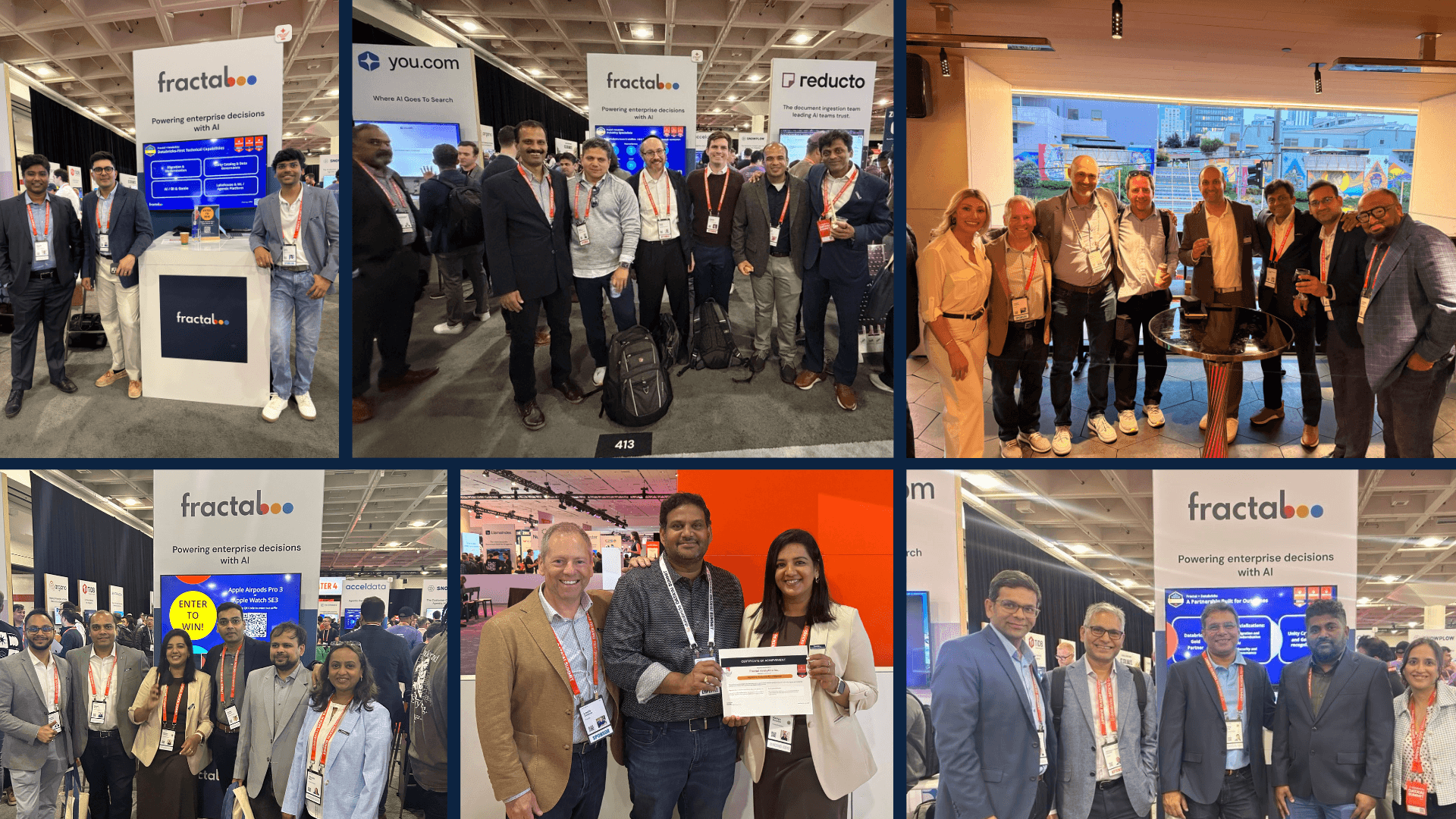
Fractal team at the Data + AI Summit 2026
Recent Blogs