Mastering global data management
Author

Shreesha Hegde
Client Partner, Cloud & Data Tech
Summary
Master Data Management provides the data foundation that global enterprises need to operate consistently across regions, functions, and systems. Its importance increases in a Global Business Services environment, where standardized processes and integrated service delivery depend on reliable master data.
This paper focuses on three areas:
The role of MDM in GBS: how a common data foundation supports integrated service delivery and scale across functions and geographies.
Key MDM models: consolidation, registry, centralized (co-existence), and transactional approaches, and where each fits within a modern enterprise architecture.
The cloud-native advantage: how cloud data platforms can support scalable MDM and near real-time data sharing across regions.
Taken together, MDM, GBS, and cloud-native technologies give enterprises a practical way to reduce fragmentation while retaining the governance and control required for global operations.
Introduction
For multinational enterprises, master data is seldom managed centrally. Customer, product, supplier, and other critical records are distributed across applications, business units, and regions. Underlying systems may have been implemented at different times for various purposes, and regulatory and operating requirements differ by market. Maintaining consistent and reliable master data in this environment remains a persistent challenge.
MDM addresses this challenge by harmonizing critical data assets into a trusted source of truth. It establishes a common structure for managing records across operational and analytical systems, reducing inconsistencies and providing teams with a reliable data foundation for business processes, reporting, and decision-making.
The increasing adoption of the GBS operating model makes this foundation especially important. GBS centralizes and standardizes operational and analytical processes across functions and regions. Its effectiveness depends on the ability to govern and use master data consistently at enterprise scale.
The global MDM market reflects this growing importance, with its value rising from USD 15.33 billion in 2024 to a projected USD 36.48 billion by 2029, achieving a compound annual growth rate (CAGR) of 18.93%, according to Mordor Intelligence (Mordor Intelligence, 2025)¹.
Meanwhile, cloud-native platforms are expanding implementation options for enterprises. Their scalability and cross-regional data-sharing capabilities facilitate the integration of MDM processes with modern data and business systems, including those requiring near-real-time access to master data.
The following sections examine how MDM fits within the GBS operating model, identify master data domains that require global governance, and outline the main implementation pathways for enterprises.
Emergence of the GBS operating model
Large global enterprises have increasingly used Global Business Services to bring support functions into a more coordinated service delivery model. GBS can encompass shared services, outsourcing, and centers of excellence serving multiple business units. Depending on the organization, its scope may include finance, IT, HR, procurement, and other functions, delivered through onshore or offshore teams.
The objective is not simply centralization. GBS creates a structure through which services can be standardized and scaled across business units and geographies while maintaining clear governance and accountability.
Key drivers behind the emergence of GBS
Demand for operational efficiency
Global operations involve high cost and coordination overhead. Consolidating selected services through GBS reduces duplication, improves use of shared capabilities, and captures economies of scale.Focus on standardization and scalability
Common processes and standards ensure consistent service delivery across locations. They also provide a scalable operating model as the enterprise adds markets, business units, or capabilities.Advances in technology
RPA, AI, cloud computing, advanced analytics, and digital platforms have expanded the range of support activities that can be centralized or automated. In GBS, these technologies improve efficiency and enable new service delivery methods.Shift to value-driven services
Traditional shared services focused primarily on cost reduction. GBS expands this mandate by aligning service delivery with broader business objectives, such as process improvement, innovation, and growth.Global expansion
Expansion into new markets increases the need for a support structure that provides common governance while accommodating local operating requirements. GBS helps balance enterprise-wide processes with regional execution.Compliance and risk management
Operating across jurisdictions introduces different regulatory obligations. Centralized governance can help enterprises apply common policies and maintain oversight of areas such as data management and reporting, while accommodating local requirements where necessary.
Core characteristics of GBS
Integrated delivery model: Functions that were previously managed in isolation are brought into a coordinated service delivery framework.
Customer-centric approach: Internal business units are treated as "customers," with services tailored to their requirements and expectations.
Technology-driven: Analytics, automation, and digital platforms improve processes and support decision-making.
Governance and accountability: Defined governance structures establish ownership, accountability, and alignment with enterprise objectives.
Agility and flexibility: The operating model adapts as business conditions, technologies, and market requirements evolve.
Benefits of the GBS model
Cost optimization: Centralization, standardization, and automation reduce duplication and lower the cost of selected support processes.
Improved service quality: Common processes and standards enhance the accuracy, consistency, and reliability of services across regions.
Faster decision-making: Centralized access to data and insights reduces the time needed for informed decisions.
Innovation enablement: A common operating framework simplifies the introduction and scaling of new technologies across functions.
Global collaboration: Shared processes and platforms improve coordination among geographically distributed teams.
What is MDM?
Master Data Management is the combination of processes, governance frameworks, and technologies used to manage the critical business entities an organization depends on. This "master data" typically includes customers, products, parts, suppliers, employees, and other core entities required for business operations and decision-making.
MDM's purpose is to keep these records accurate, consistent, and usable across operational and analytical systems, departments, and locations. Rather than allowing different systems to maintain conflicting versions of the same entity, MDM establishes a trusted representation that can be governed and shared across the enterprise.
The role of MDM in the GBS model
GBS brings multiple support functions into a coordinated operating framework. Coordination is hindered when finance, HR, IT, procurement, supply chain, and other functions use inconsistent definitions or conflicting records for the same customers, suppliers, products, or employees.
MDM addresses this challenge at the data layer. By establishing common models, standards, and governance for master data, it provides GBS functions with a reliable foundation to standardize processes, integrate systems, and scale service delivery.
Why MDM matters in a GBS environment
Unified data foundation for integrated services
GBS integrates functions that often operate across different systems and geographies. MDM establishes a common data model for critical assets such as customer records, supplier information, products or parts, and financial data. This reduces the risk of integrated business processes relying on inconsistent versions of the same entity.Standardization across functions and regions
Process standardization relies on data standardization. MDM defines and enforces common data standards, policies, and governance mechanisms, so regional and functional processes do not need to compensate for avoidable differences in master data.Enhanced decision-making through accurate data
Advanced analytics, business intelligence (BI), and real-time decision-making are only as reliable as their inputs. MDM enhances the accuracy and completeness of master data used by these systems, providing GBS and enterprise teams with a more dependable basis for analysis.Seamless technology integration
GBS environments increasingly use RPA, AI, cloud platforms, Enterprise Resource Planning (ERP), and Customer Relationship Management (CRM) systems within integrated workflows. MDM ensures consistent underlying records across these technologies, reducing data discrepancies that could otherwise propagate through automated processes.Improved compliance and risk management
Global enterprises operate under multiple regulatory regimes. Accurate, traceable, and auditable master data supports compliance with global and local requirements, including regulations such as the General Data Protection Regulation (2016) and the Sarbanes-Oxley Act (2002).Support for scalability and agility
As a GBS organization adds markets, functions, technologies, or processes, master data volume and complexity increase. An established MDM framework provides a controlled way to manage this growth without introducing new regional or system-level inconsistencies.Optimization of cost and efficiency
Poor master data increases workload: duplicate records must be reconciled, errors corrected, and teams spend time resolving system differences. MDM reduces these avoidable activities and supports the efficiency goals of a centralized GBS model.Enhanced customer and employee experience
Consistent customer and employee records directly impact service quality. Up-to-date master data enables internal and external service teams to work with the same information, supporting more relevant interactions and efficient service delivery.
Critical global master domains
Core master data domains are vital for ensuring consistency, efficiency, and seamless operations across global enterprises.
Global enterprises in industries such as CPG, Manufacturing, and Logistics operate in highly complex ecosystems that rely on the accuracy and consistency of master data across regions and functions. Below are the critical global master data domains that are essential for enabling seamless operations, efficient procurement, and manufacturing:
Type | Definition | Key attributes | Relevance |
|---|---|---|---|
Product or part master | Data related to products and services offered by the organization, including stock-keeping units, specifications, and lifecycle details |
| Ensures consistency across manufacturing, supply chain, and sales processes, enabling efficient production planning and procurement, inventory management, and marketing efforts |
Customer master | Data related to the organization’s customers, including their profiles and interactions, constitutes global customer master data, which is particularly relevant for B2B firms as they typically deal with cross-regional customers |
| Vital for personalized customer experiences, targeted marketing, and effective order-to-cash processes |
Supplier/vendor master | Information about suppliers and vendors involved in the procurement process |
| Enhances supplier relationship management, reduces procurement inefficiencies, reduces risk, and ensures supply chain resilience |
Employee/ workforce master | Data related to the organization’s employees and workforce structure |
| Supports workforce planning, compliance with labor laws, and employee engagement strategies |
Types of global MDM models and implementation pathways
No single MDM architecture fits every enterprise. The main models differ in master data storage, the level of control the MDM layer has over source systems, and whether the primary requirement is analytical or operational. These choices also affect implementation complexity, investment, and the role of cloud-native data platforms.
In a consolidation model, master data from multiple source systems is brought into a central repository for reporting and analysis. The source systems remain unchanged. Records are collected and reconciled centrally to create a consistent "single view" of the data.
Key features:
Master data is collected and reconciled, but it is not actively updated in the source systems
The system acts as a central "read-only" hub, primarily used for data analysis
Because it does not require write-back to source systems, consolidation-style MDM is generally less complex to implement and requires lower upfront and ongoing investment than operational MDM models. The consolidated data supports BI reporting, analytics, and data science workloads. In large enterprises, this analytical MDM layer is often built on modern cloud data platforms such as Snowflake, Databricks, and BigQuery.
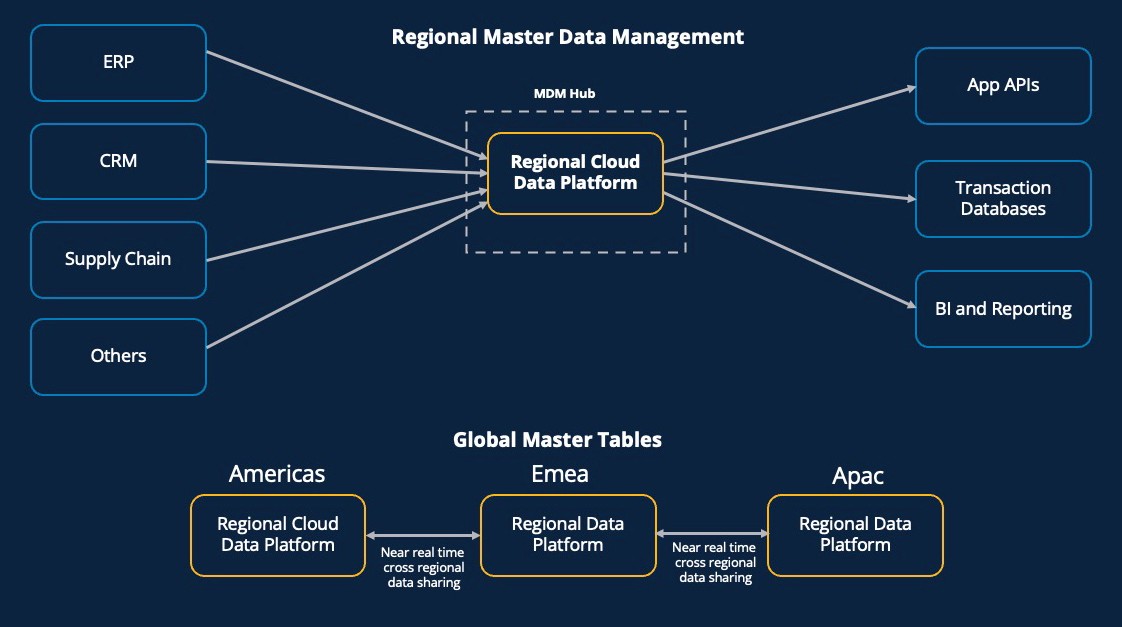
Fig. 1: Regional consolidation-style analytical MDM implementation and the creation of a global master table using near real-time, cross-regional data sharing
A registry model links and reconciles master data across systems through a central index. The registry does not serve as the primary store for master records; instead, it maintains pointers to the systems where those records reside.
Key features:
Provides a "virtual" single view of data
Master data remains in the source systems, with the registry resolving duplicates and inconsistencies
Low control over master data residing in source systems
Registry-style MDM can be implemented quickly because it does not require updating underlying source records. The trade-off is that the registry contains indexes rather than a complete global master table, so building such a table requires additional processing. This approach is less common in large global enterprises.
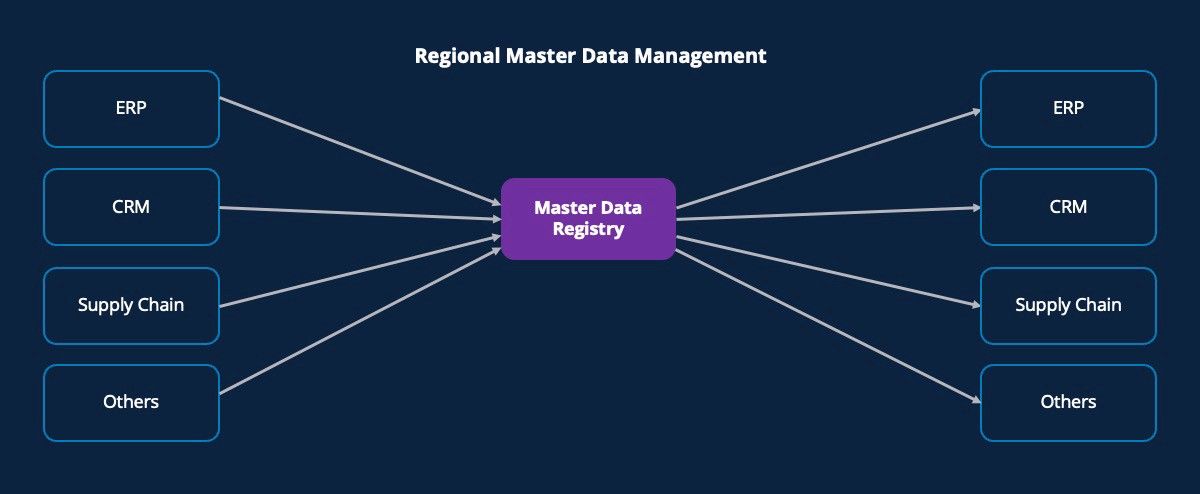
Fig. 2: Regional registry-style MDM implementation
In a centralized or co-existence model, a master copy of the data is maintained in a central hub. The hub serves as the authoritative source for downstream systems while operating alongside the source systems that contribute master data.
Key features:
The central hub both stores and distributes master data
It enables updates in both the hub and source systems in near real-time, ensuring synchronization
This model requires greater investment than analytical or registry approaches and takes longer to implement because the MDM hub must align with operational systems that both contribute to and consume master data. Large enterprises use this model when a high degree of control over business-critical data is needed across operational and analytical systems. MDM platforms supporting this approach include Informatica, Reltio, Boomi Data Hub, and Profisee.
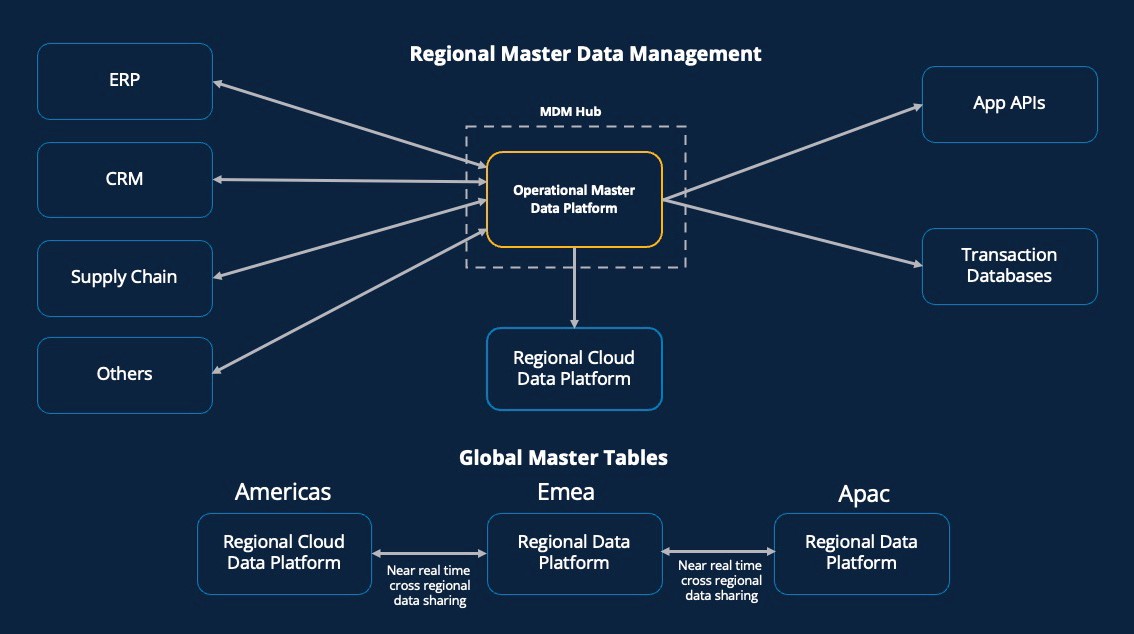
Fig. 3: Regional MDM implementation with bi-directional integration with operational systems and the creation of a global master table using cloud-native data platforms
Transactional MDM moves governance to the point where master data is created or changed. Instead of correcting and reconciling records downstream, data standards and controls are embedded directly into transactional systems.
Key features:
Master data updates are tightly integrated with operational transactions
Real-time data validation and synchronization and ensured
This type ensures enterprises do not need to build any downstream MDM processes to manage master data
Architecturally, this is an attractive end state because data quality is addressed at the source. However, in a global enterprise, achieving this consistently is challenging. The number of disparate source systems, processes, and regional requirements means embedding MDM governance into every relevant transaction can require substantial time, effort, and investment.

Fig. 4: Transactional enterprise systems with embedded MDM governance
Conclusion
Global MDM provides the data discipline required for a GBS operating model to function consistently across functions and regions.
GBS depends on integrated processes, reliable service delivery, and informed decision-making. Each becomes more difficult when the enterprise works with conflicting versions of customers, suppliers, products, parts, or employees.
A well-designed MDM strategy addresses this complexity by defining how critical master data is governed, reconciled, and shared. The appropriate implementation model will depend on the enterprise architecture, the degree of control required over source systems, and whether the immediate priority is analytical or operational.
Cloud-native data platforms expand available implementation options. Their scalability and near real-time, cross-regional data-sharing capabilities support global master tables while allowing governance to remain centralized and execution to accommodate local requirements. Data virtualization, automation, and built-in compliance features further reduce the operational effort required to maintain global master data.
For enterprises building or expanding GBS, the key question is not whether to govern master data globally, but how much centralization and control the business requires, where that control should reside, and which MDM model best fits the existing technology landscape.
Introduction
For multinational enterprises, master data is seldom managed centrally. Customer, product, supplier, and other critical records are distributed across applications, business units, and regions. Underlying systems may have been implemented at different times for various purposes, and regulatory and operating requirements differ by market. Maintaining consistent and reliable master data in this environment remains a persistent challenge.
MDM addresses this challenge by harmonizing critical data assets into a trusted source of truth. It establishes a common structure for managing records across operational and analytical systems, reducing inconsistencies and providing teams with a reliable data foundation for business processes, reporting, and decision-making.
The increasing adoption of the GBS operating model makes this foundation especially important. GBS centralizes and standardizes operational and analytical processes across functions and regions. Its effectiveness depends on the ability to govern and use master data consistently at enterprise scale.
The global MDM market reflects this growing importance, with its value rising from USD 15.33 billion in 2024 to a projected USD 36.48 billion by 2029, achieving a compound annual growth rate (CAGR) of 18.93%, according to Mordor Intelligence (Mordor Intelligence, 2025)¹.
Meanwhile, cloud-native platforms are expanding implementation options for enterprises. Their scalability and cross-regional data-sharing capabilities facilitate the integration of MDM processes with modern data and business systems, including those requiring near-real-time access to master data.
The following sections examine how MDM fits within the GBS operating model, identify master data domains that require global governance, and outline the main implementation pathways for enterprises.
Emergence of the GBS operating model
Large global enterprises have increasingly used Global Business Services to bring support functions into a more coordinated service delivery model. GBS can encompass shared services, outsourcing, and centers of excellence serving multiple business units. Depending on the organization, its scope may include finance, IT, HR, procurement, and other functions, delivered through onshore or offshore teams.
The objective is not simply centralization. GBS creates a structure through which services can be standardized and scaled across business units and geographies while maintaining clear governance and accountability.
Key drivers behind the emergence of GBS
Demand for operational efficiency
Global operations involve high cost and coordination overhead. Consolidating selected services through GBS reduces duplication, improves use of shared capabilities, and captures economies of scale.Focus on standardization and scalability
Common processes and standards ensure consistent service delivery across locations. They also provide a scalable operating model as the enterprise adds markets, business units, or capabilities.Advances in technology
RPA, AI, cloud computing, advanced analytics, and digital platforms have expanded the range of support activities that can be centralized or automated. In GBS, these technologies improve efficiency and enable new service delivery methods.Shift to value-driven services
Traditional shared services focused primarily on cost reduction. GBS expands this mandate by aligning service delivery with broader business objectives, such as process improvement, innovation, and growth.Global expansion
Expansion into new markets increases the need for a support structure that provides common governance while accommodating local operating requirements. GBS helps balance enterprise-wide processes with regional execution.Compliance and risk management
Operating across jurisdictions introduces different regulatory obligations. Centralized governance can help enterprises apply common policies and maintain oversight of areas such as data management and reporting, while accommodating local requirements where necessary.
Core characteristics of GBS
Integrated delivery model: Functions that were previously managed in isolation are brought into a coordinated service delivery framework.
Customer-centric approach: Internal business units are treated as "customers," with services tailored to their requirements and expectations.
Technology-driven: Analytics, automation, and digital platforms improve processes and support decision-making.
Governance and accountability: Defined governance structures establish ownership, accountability, and alignment with enterprise objectives.
Agility and flexibility: The operating model adapts as business conditions, technologies, and market requirements evolve.
Benefits of the GBS model
Cost optimization: Centralization, standardization, and automation reduce duplication and lower the cost of selected support processes.
Improved service quality: Common processes and standards enhance the accuracy, consistency, and reliability of services across regions.
Faster decision-making: Centralized access to data and insights reduces the time needed for informed decisions.
Innovation enablement: A common operating framework simplifies the introduction and scaling of new technologies across functions.
Global collaboration: Shared processes and platforms improve coordination among geographically distributed teams.
What is MDM?
Master Data Management is the combination of processes, governance frameworks, and technologies used to manage the critical business entities an organization depends on. This "master data" typically includes customers, products, parts, suppliers, employees, and other core entities required for business operations and decision-making.
MDM's purpose is to keep these records accurate, consistent, and usable across operational and analytical systems, departments, and locations. Rather than allowing different systems to maintain conflicting versions of the same entity, MDM establishes a trusted representation that can be governed and shared across the enterprise.
The role of MDM in the GBS model
GBS brings multiple support functions into a coordinated operating framework. Coordination is hindered when finance, HR, IT, procurement, supply chain, and other functions use inconsistent definitions or conflicting records for the same customers, suppliers, products, or employees.
MDM addresses this challenge at the data layer. By establishing common models, standards, and governance for master data, it provides GBS functions with a reliable foundation to standardize processes, integrate systems, and scale service delivery.
Why MDM matters in a GBS environment
Unified data foundation for integrated services
GBS integrates functions that often operate across different systems and geographies. MDM establishes a common data model for critical assets such as customer records, supplier information, products or parts, and financial data. This reduces the risk of integrated business processes relying on inconsistent versions of the same entity.Standardization across functions and regions
Process standardization relies on data standardization. MDM defines and enforces common data standards, policies, and governance mechanisms, so regional and functional processes do not need to compensate for avoidable differences in master data.Enhanced decision-making through accurate data
Advanced analytics, business intelligence (BI), and real-time decision-making are only as reliable as their inputs. MDM enhances the accuracy and completeness of master data used by these systems, providing GBS and enterprise teams with a more dependable basis for analysis.Seamless technology integration
GBS environments increasingly use RPA, AI, cloud platforms, Enterprise Resource Planning (ERP), and Customer Relationship Management (CRM) systems within integrated workflows. MDM ensures consistent underlying records across these technologies, reducing data discrepancies that could otherwise propagate through automated processes.Improved compliance and risk management
Global enterprises operate under multiple regulatory regimes. Accurate, traceable, and auditable master data supports compliance with global and local requirements, including regulations such as the General Data Protection Regulation (2016) and the Sarbanes-Oxley Act (2002).Support for scalability and agility
As a GBS organization adds markets, functions, technologies, or processes, master data volume and complexity increase. An established MDM framework provides a controlled way to manage this growth without introducing new regional or system-level inconsistencies.Optimization of cost and efficiency
Poor master data increases workload: duplicate records must be reconciled, errors corrected, and teams spend time resolving system differences. MDM reduces these avoidable activities and supports the efficiency goals of a centralized GBS model.Enhanced customer and employee experience
Consistent customer and employee records directly impact service quality. Up-to-date master data enables internal and external service teams to work with the same information, supporting more relevant interactions and efficient service delivery.
Critical global master domains
Core master data domains are vital for ensuring consistency, efficiency, and seamless operations across global enterprises.
Global enterprises in industries such as CPG, Manufacturing, and Logistics operate in highly complex ecosystems that rely on the accuracy and consistency of master data across regions and functions. Below are the critical global master data domains that are essential for enabling seamless operations, efficient procurement, and manufacturing:
Type | Definition | Key attributes | Relevance |
|---|---|---|---|
Product or part master | Data related to products and services offered by the organization, including stock-keeping units, specifications, and lifecycle details |
| Ensures consistency across manufacturing, supply chain, and sales processes, enabling efficient production planning and procurement, inventory management, and marketing efforts |
Customer master | Data related to the organization’s customers, including their profiles and interactions, constitutes global customer master data, which is particularly relevant for B2B firms as they typically deal with cross-regional customers |
| Vital for personalized customer experiences, targeted marketing, and effective order-to-cash processes |
Supplier/vendor master | Information about suppliers and vendors involved in the procurement process |
| Enhances supplier relationship management, reduces procurement inefficiencies, reduces risk, and ensures supply chain resilience |
Employee/ workforce master | Data related to the organization’s employees and workforce structure |
| Supports workforce planning, compliance with labor laws, and employee engagement strategies |
Types of global MDM models and implementation pathways
No single MDM architecture fits every enterprise. The main models differ in master data storage, the level of control the MDM layer has over source systems, and whether the primary requirement is analytical or operational. These choices also affect implementation complexity, investment, and the role of cloud-native data platforms.
In a consolidation model, master data from multiple source systems is brought into a central repository for reporting and analysis. The source systems remain unchanged. Records are collected and reconciled centrally to create a consistent "single view" of the data.
Key features:
Master data is collected and reconciled, but it is not actively updated in the source systems
The system acts as a central "read-only" hub, primarily used for data analysis
Because it does not require write-back to source systems, consolidation-style MDM is generally less complex to implement and requires lower upfront and ongoing investment than operational MDM models. The consolidated data supports BI reporting, analytics, and data science workloads. In large enterprises, this analytical MDM layer is often built on modern cloud data platforms such as Snowflake, Databricks, and BigQuery.
Fig. 1: Regional consolidation-style analytical MDM implementation and the creation of a global master table using near real-time, cross-regional data sharing
A registry model links and reconciles master data across systems through a central index. The registry does not serve as the primary store for master records; instead, it maintains pointers to the systems where those records reside.
Key features:
Provides a "virtual" single view of data
Master data remains in the source systems, with the registry resolving duplicates and inconsistencies
Low control over master data residing in source systems
Registry-style MDM can be implemented quickly because it does not require updating underlying source records. The trade-off is that the registry contains indexes rather than a complete global master table, so building such a table requires additional processing. This approach is less common in large global enterprises.
Fig. 2: Regional registry-style MDM implementation
In a centralized or co-existence model, a master copy of the data is maintained in a central hub. The hub serves as the authoritative source for downstream systems while operating alongside the source systems that contribute master data.
Key features:
The central hub both stores and distributes master data
It enables updates in both the hub and source systems in near real-time, ensuring synchronization
This model requires greater investment than analytical or registry approaches and takes longer to implement because the MDM hub must align with operational systems that both contribute to and consume master data. Large enterprises use this model when a high degree of control over business-critical data is needed across operational and analytical systems. MDM platforms supporting this approach include Informatica, Reltio, Boomi Data Hub, and Profisee.
Fig. 3: Regional MDM implementation with bi-directional integration with operational systems and the creation of a global master table using cloud-native data platforms
Transactional MDM moves governance to the point where master data is created or changed. Instead of correcting and reconciling records downstream, data standards and controls are embedded directly into transactional systems.
Key features:
Master data updates are tightly integrated with operational transactions
Real-time data validation and synchronization and ensured
This type ensures enterprises do not need to build any downstream MDM processes to manage master data
Architecturally, this is an attractive end state because data quality is addressed at the source. However, in a global enterprise, achieving this consistently is challenging. The number of disparate source systems, processes, and regional requirements means embedding MDM governance into every relevant transaction can require substantial time, effort, and investment.
Fig. 4: Transactional enterprise systems with embedded MDM governance
Conclusion
Global MDM provides the data discipline required for a GBS operating model to function consistently across functions and regions.
GBS depends on integrated processes, reliable service delivery, and informed decision-making. Each becomes more difficult when the enterprise works with conflicting versions of customers, suppliers, products, parts, or employees.
A well-designed MDM strategy addresses this complexity by defining how critical master data is governed, reconciled, and shared. The appropriate implementation model will depend on the enterprise architecture, the degree of control required over source systems, and whether the immediate priority is analytical or operational.
Cloud-native data platforms expand available implementation options. Their scalability and near real-time, cross-regional data-sharing capabilities support global master tables while allowing governance to remain centralized and execution to accommodate local requirements. Data virtualization, automation, and built-in compliance features further reduce the operational effort required to maintain global master data.
For enterprises building or expanding GBS, the key question is not whether to govern master data globally, but how much centralization and control the business requires, where that control should reside, and which MDM model best fits the existing technology landscape.
References
1 (2025). Master Data Management Market Size — Industry report on share, growth trends & forecasts analysis (2025-2030). Retrieved January 22, 2025, from https://www.mordorintelligence.com/industry-reports/master-data-management-market.
Recognition and achievements
Select Fractal accolades

Leader
The Forrester Wave: Customer Analytics Services Q2, 2025

Representative vendor
Gartner Hype Cycle for Consumer Goods, 2026

Great Place to Work
Great Place to Work® across four regions: India (9th year), USA (5th year), UK (5th year) and UAE (2nd year)
Recognition and achievements
Select Fractal accolades
Leader
The Forrester Wave: Customer Analytics Services Q2, 2025
Representative vendor
Gartner Hype Cycle for Consumer Goods, 2026
Great Place to Work
Great Place to Work® across four regions: India (9th year), USA (5th year), UK (5th year) and UAE (2nd year)