From dirty data to trusted decisions: The strategic role of master data management
Authors

Arpita Jain
Imagineer, Consulting CPG

Abhishek Shahji
Engagement Manager, Consulting Insurance

Paras Sharma
Senior Consultant, Consulting CPG
Why MDM fails: The causes nobody talks about
Master data management (MDM) governs how your organization prices products, serves customers, runs supply chains, and makes executive decisions. Yet, many MDM initiatives fail to meet business objectives, not because of bad software, but because of predictable, preventable mistakes.
The most dangerous aspect of MDM failure is its invisibility. Bad master data doesn't trigger alarms. It accumulates silently through duplicate customer records, mispriced products, and inventory signals that don't reflect reality until the business hits a breaking point it cannot quickly recover from.
Root cause | The real-world damage |
|---|---|
MDM treated as an IT project, not a business program | No commercial KPIs → executive sponsorship collapses at first budget pressure |
Dirty data migrated without cleansing | Modern platforms amplify every error across every connected system simultaneously |
Governance exists on paper only | Departments build shadow spreadsheets; multiple conflicting 'truths' persist |
Integration tested in isolation, not end-to-end | A product change in MDM cascades into pricing, tax, WMS, and POS failures no one predicted |
Change management ignored | Users distrust the new system and revert to old processes, defeating the program's purpose |
AI built on unvalidated master data | Machine learning amplifies data errors into systematically wrong decisions at machine speed |

Case study: A $107 million wake-up call
Theoretical arguments for MDM investment rarely move boardroom decisions. What does move them is the quantified reality of what happens when MDM is neglected at scale. The following case, drawn from publicly reported retail industry analysis, is the most significant data governance failure of recent years.

Dirty data migration: Incomplete, inconsistent master data was migrated without profiling or cleansing. The ERP platform faithfully distributed every error to every connected system.
Pricing breakdown: Faulty product master caused incorrect point-of-sale pricing and unreliable margin reporting. Leadership could not identify profitable vs. loss-making categories.
Warehouse collapse: The ERP and warehouse management systems failed to reconcile migrated stock data, causing shortages, distribution delays, and lost sales across the network.
Rushed go-live: Known data quality issues were overridden by operational pressure. This single governance failure made every other problem unrecoverable.
$107M write-off: After months of costly manual workarounds failing to stabilize operations, the entire implementation was written off. Revenue losses of 34% were reported in affected divisions.
The core truth
The platform did not fail. The master data failed. Enterprise systems are designed to execute at scale, not to correct underlying data quality issues. When inaccurate or inconsistent data is migrated, the platform simply accelerates its spread across processes, reports, and decisions. This was not the cost of bad software; it was the cost of loading poor-quality data into a system capable of amplifying its consequences.
Our approach: Making MDM deliver real value
The difference between MDM programs that succeed and those that collapse is not technology selection; it is methodology, sequencing, and governance rigor.
Business alignment:
Anchor master data management initiatives to 3–5 measurable business outcomes, such as pricing accuracy, operational efficiency, and compliance risk mitigation. Success depends on business ownership and strategic alignment, not just technology implementation.
Data health assessment:
Profile every source system for completeness, uniqueness, consistency, and accuracy. Score each master data domain. Any domain below 70% quality on two dimensions is a critical risk. In such cases, do not migrate.
Governance by design:
Assign named data owners per domain, enforce validation rules at point of entry, define escalation paths for conflicts. Governance on paper is not governance. It requires enforcement mechanisms.
Clean before you migrate:
Profile → Cleanse → Standardize → Enrich → Mock migrate → Reconcile → Gate approval. The gate approval is non-negotiable: no go-live until data meets the defined threshold.
End-to-end integration testing:
Test real business events across all connected systems simultaneously, not each system in isolation. A product change should be validated across the master data platform, warehouse management system, point-of-sale system, e-commerce platform, and finance systems within a single test cycle.
Why this approach works
The MDM market offers two broad options: technology vendors who sell platforms and system integrators who configure them. Fractal is placed at a different intersection: data science and AI capability at enterprise scale, combined with MDM domain expertise and a governance-first delivery methodology.
| Traditional approach | The gap it creates | Fractal approach |
|---|---|---|
| Configure and hand over | No governance continuity; data quality drifts within months | Build stewardship communities that sustain quality post go-live |
| Migrate all data, fix issues later | Errors distribute across every connected system at once | Zero dirty-data policy; quality gated before any migration |
| Test in system silos | Integration failures surface in production, not testing | End-to-end event simulation at production data volumes |
| MDM separate from AI strategy | AI trained on inconsistent data amplifies every error | MDM governance and AI governance designed as a unified layer |
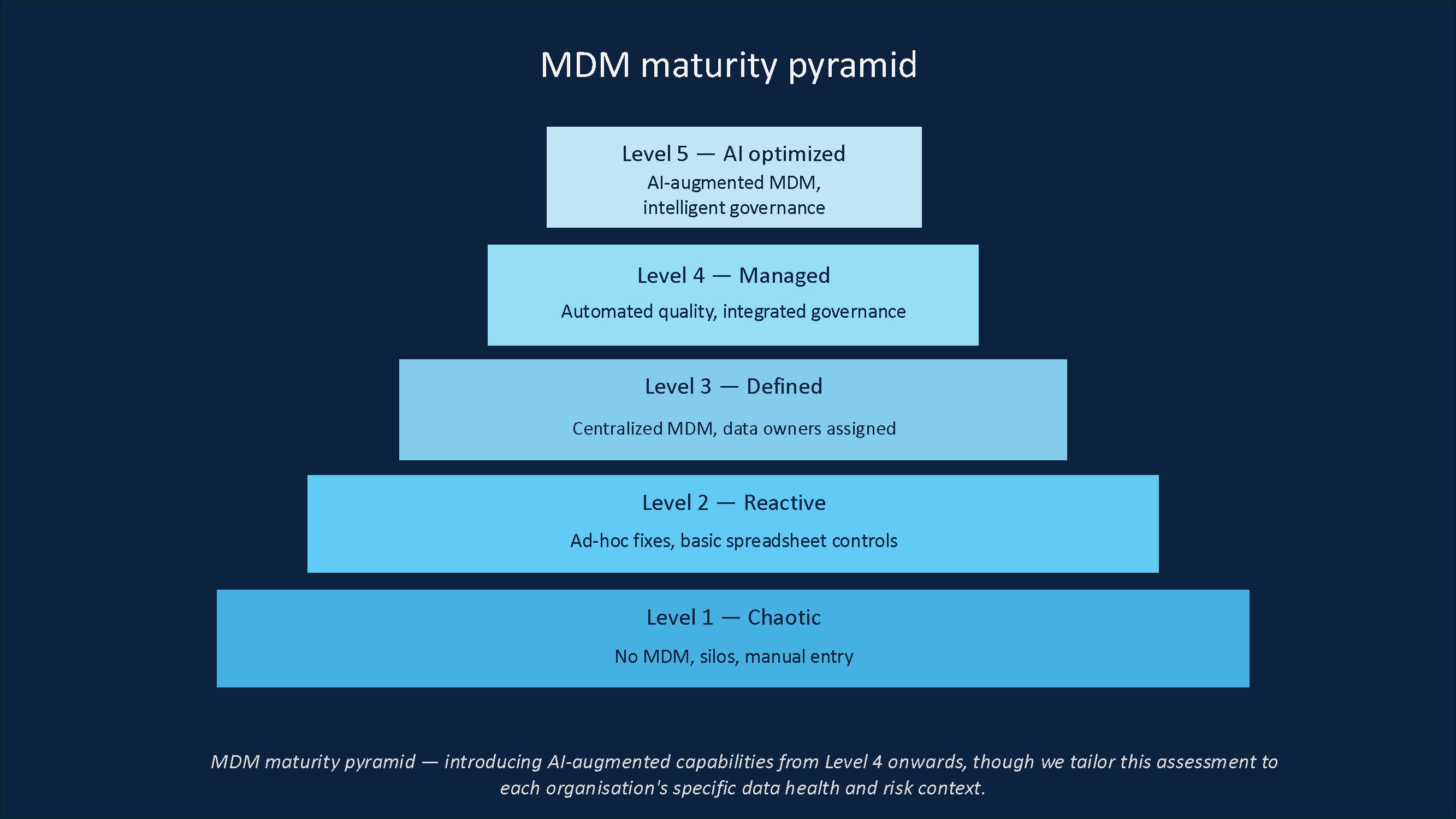
MDM maturity is a journey, not a one-time implementation. Organizations typically evolve through multiple stages, from fragmented and reactive data management practices to governed, automated, and ultimately AI-augmented operating models. Understanding current maturity helps define the right roadmap, investments, and governance priorities.
AI and MDM: Our advantage in the intelligence era
AI is no longer a future investment; it is a current competitive differentiator. But market research makes a critical finding clear: 68% of AI-first organizations have mature, well-established data and governance frameworks, compared to just 32% of others. The organizations winning with AI are not the ones who deployed AI fastest. They are the ones who built clean data foundations first.
What our AI-augmented MDM delivers
Data quality at speed:
AI recommends and applies data quality rules, visualizes results in real time, and executes cleansing, standardization, and reference data harmonization automatically.
Faster onboarding and classification:
Auto-tagging, data classification, and enrichment using agentic AI, reducing the time to create a trusted domain from months to weeks.
Intelligent entity resolution:
Probabilistic AI-powered matching identifies duplicates across unstructured and structured data with greater than 99% accuracy, far beyond rule-based approaches.
Enhanced stewardship:
AI creates taxonomies, maps glossaries, assigns ownership, and flags anomalies automatically, so your data stewards focus on decisions rather than manual detection.
Privacy and protection:
Dynamic data masking, automated Data Subject Access Request processing, and AI-driven policy enforcement based on user role and jurisdiction.
Your data is either a strategic asset or a strategic liability. The difference is how you govern it.
Why MDM fails: The causes nobody talks about
Master data management (MDM) governs how your organization prices products, serves customers, runs supply chains, and makes executive decisions. Yet, many MDM initiatives fail to meet business objectives, not because of bad software, but because of predictable, preventable mistakes.
The most dangerous aspect of MDM failure is its invisibility. Bad master data doesn't trigger alarms. It accumulates silently through duplicate customer records, mispriced products, and inventory signals that don't reflect reality until the business hits a breaking point it cannot quickly recover from.
Root cause | The real-world damage |
|---|---|
MDM treated as an IT project, not a business program | No commercial KPIs → executive sponsorship collapses at first budget pressure |
Dirty data migrated without cleansing | Modern platforms amplify every error across every connected system simultaneously |
Governance exists on paper only | Departments build shadow spreadsheets; multiple conflicting 'truths' persist |
Integration tested in isolation, not end-to-end | A product change in MDM cascades into pricing, tax, WMS, and POS failures no one predicted |
Change management ignored | Users distrust the new system and revert to old processes, defeating the program's purpose |
AI built on unvalidated master data | Machine learning amplifies data errors into systematically wrong decisions at machine speed |
Case study: A $107 million wake-up call
Theoretical arguments for MDM investment rarely move boardroom decisions. What does move them is the quantified reality of what happens when MDM is neglected at scale. The following case, drawn from publicly reported retail industry analysis, is the most significant data governance failure of recent years.
Dirty data migration: Incomplete, inconsistent master data was migrated without profiling or cleansing. The ERP platform faithfully distributed every error to every connected system.
Pricing breakdown: Faulty product master caused incorrect point-of-sale pricing and unreliable margin reporting. Leadership could not identify profitable vs. loss-making categories.
Warehouse collapse: The ERP and warehouse management systems failed to reconcile migrated stock data, causing shortages, distribution delays, and lost sales across the network.
Rushed go-live: Known data quality issues were overridden by operational pressure. This single governance failure made every other problem unrecoverable.
$107M write-off: After months of costly manual workarounds failing to stabilize operations, the entire implementation was written off. Revenue losses of 34% were reported in affected divisions.
The core truth
The platform did not fail. The master data failed. Enterprise systems are designed to execute at scale, not to correct underlying data quality issues. When inaccurate or inconsistent data is migrated, the platform simply accelerates its spread across processes, reports, and decisions. This was not the cost of bad software; it was the cost of loading poor-quality data into a system capable of amplifying its consequences.
Our approach: Making MDM deliver real value
The difference between MDM programs that succeed and those that collapse is not technology selection; it is methodology, sequencing, and governance rigor.
Business alignment:
Anchor master data management initiatives to 3–5 measurable business outcomes, such as pricing accuracy, operational efficiency, and compliance risk mitigation. Success depends on business ownership and strategic alignment, not just technology implementation.
Data health assessment:
Profile every source system for completeness, uniqueness, consistency, and accuracy. Score each master data domain. Any domain below 70% quality on two dimensions is a critical risk. In such cases, do not migrate.
Governance by design:
Assign named data owners per domain, enforce validation rules at point of entry, define escalation paths for conflicts. Governance on paper is not governance. It requires enforcement mechanisms.
Clean before you migrate:
Profile → Cleanse → Standardize → Enrich → Mock migrate → Reconcile → Gate approval. The gate approval is non-negotiable: no go-live until data meets the defined threshold.
End-to-end integration testing:
Test real business events across all connected systems simultaneously, not each system in isolation. A product change should be validated across the master data platform, warehouse management system, point-of-sale system, e-commerce platform, and finance systems within a single test cycle.
Why this approach works
The MDM market offers two broad options: technology vendors who sell platforms and system integrators who configure them. Fractal is placed at a different intersection: data science and AI capability at enterprise scale, combined with MDM domain expertise and a governance-first delivery methodology.
| Traditional approach | The gap it creates | Fractal approach |
|---|---|---|
| Configure and hand over | No governance continuity; data quality drifts within months | Build stewardship communities that sustain quality post go-live |
| Migrate all data, fix issues later | Errors distribute across every connected system at once | Zero dirty-data policy; quality gated before any migration |
| Test in system silos | Integration failures surface in production, not testing | End-to-end event simulation at production data volumes |
| MDM separate from AI strategy | AI trained on inconsistent data amplifies every error | MDM governance and AI governance designed as a unified layer |
MDM maturity is a journey, not a one-time implementation. Organizations typically evolve through multiple stages, from fragmented and reactive data management practices to governed, automated, and ultimately AI-augmented operating models. Understanding current maturity helps define the right roadmap, investments, and governance priorities.
AI and MDM: Our advantage in the intelligence era
AI is no longer a future investment; it is a current competitive differentiator. But market research makes a critical finding clear: 68% of AI-first organizations have mature, well-established data and governance frameworks, compared to just 32% of others. The organizations winning with AI are not the ones who deployed AI fastest. They are the ones who built clean data foundations first.
What our AI-augmented MDM delivers
Data quality at speed:
AI recommends and applies data quality rules, visualizes results in real time, and executes cleansing, standardization, and reference data harmonization automatically.
Faster onboarding and classification:
Auto-tagging, data classification, and enrichment using agentic AI, reducing the time to create a trusted domain from months to weeks.
Intelligent entity resolution:
Probabilistic AI-powered matching identifies duplicates across unstructured and structured data with greater than 99% accuracy, far beyond rule-based approaches.
Enhanced stewardship:
AI creates taxonomies, maps glossaries, assigns ownership, and flags anomalies automatically, so your data stewards focus on decisions rather than manual detection.
Privacy and protection:
Dynamic data masking, automated Data Subject Access Request processing, and AI-driven policy enforcement based on user role and jurisdiction.
Your data is either a strategic asset or a strategic liability. The difference is how you govern it.
References:
Gartner: 75% of MDM programs fail & 90% lack KPIs — Dataversity analysis
Veridion: 75% of MDM initiatives miss business objectives (citing Gartner)
Gartner Data Quality topic page: $12.9M average annual cost of poor data quality
Dataversity: The real cost of bad data (Gartner $12.9M cited)
Integrate.io: 50+ data quality statistics including Gartner & MIT Sloan findings
IBM Think: Why AI data quality is the key to AI success (68% stat)
Ataccama/Forrester TEI: Expected ROI from a successful data management program
Recognition and achievements
Select Fractal accolades

Leader
The Forrester Wave: Customer Analytics Services Q2, 2025

Representative vendor
Gartner Hype Cycle for Consumer Goods, 2026

Great Place to Work
Great Place to Work® across four regions: India (9th year), USA (5th year), UK (5th year) and UAE (2nd year)
Recognition and achievements
Select Fractal accolades
Leader
The Forrester Wave: Customer Analytics Services Q2, 2025
Representative vendor
Gartner Hype Cycle for Consumer Goods, 2026
Great Place to Work
Great Place to Work® across four regions: India (9th year), USA (5th year), UK (5th year) and UAE (2nd year)