/
/
From application-centric to product-centric: Enterprise MDM as a data product platform
From application-centric to product-centric: Enterprise MDM as a data product platform
Authors

Subeer Sehgal
Principal Consultant

Abhishek Shahji
Engagement Manager

Shreya Pandey
Consultant
Summary
Master Data Management (MDM) has long been the foundation of enterprise data consistency, governance, and trust. As organizations deepen their reliance on analytics and AI, expectations have shifted: data must now be discoverable, contextually meaningful, reusable, and consumable across diverse business functions. This shift makes product-centric MDM viable - where master data serves not only as a governed enterprise asset but as a reusable, consumable data product. MDM retains its role as the backbone of data quality and standardization, while product-centric principles add domain-aligned curation, enriched metadata, clear ownership, and accessible delivery via APIs and data services. Evolving MDM into a data product platform enables organizations to deliver trusted, business-ready master data, accelerating decision-making, cross-functional collaboration, and AI-driven initiatives.
From application-centric to product-centric thinking
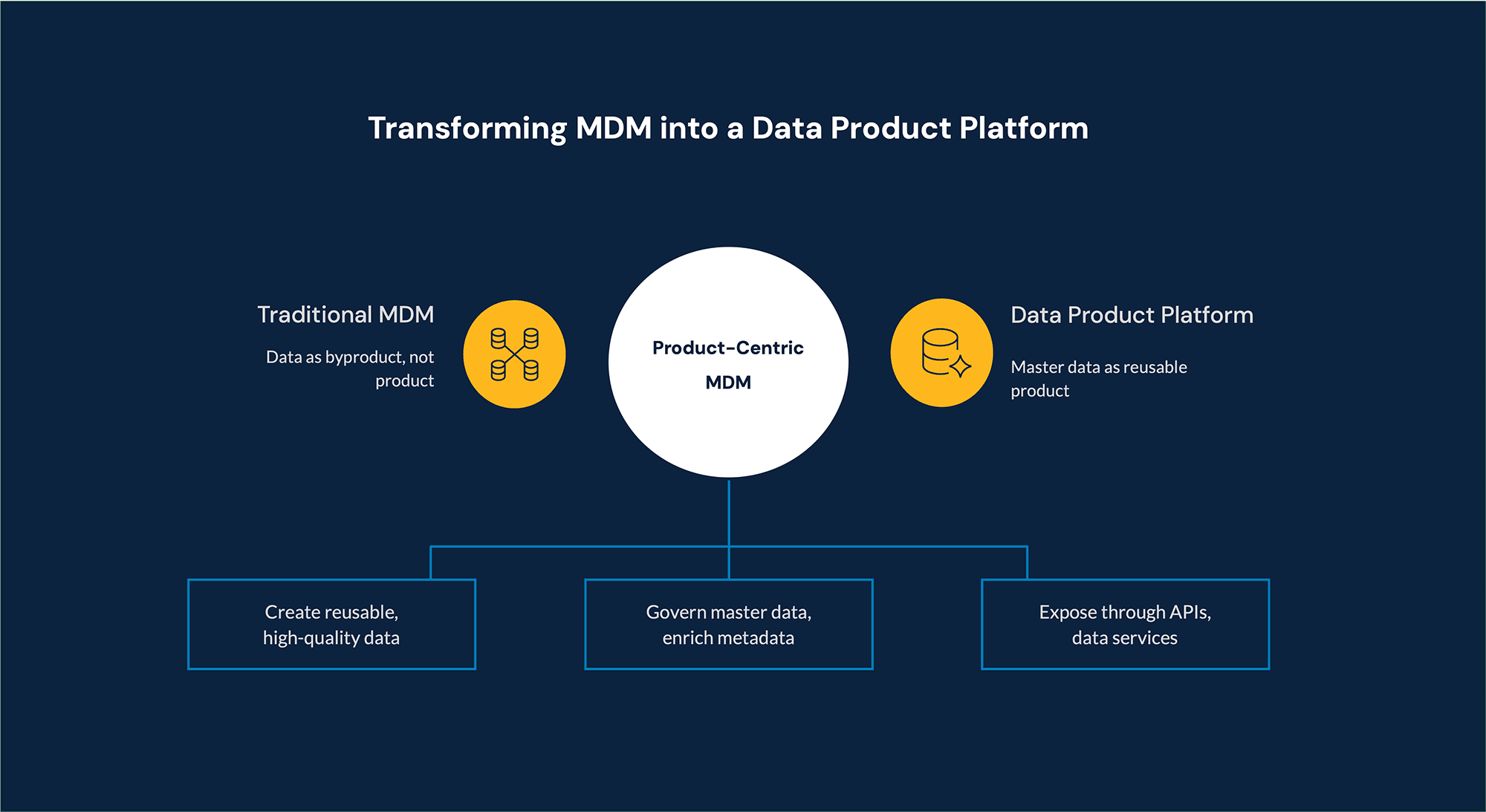
A product-centric approach treats data as a product rather than a byproduct of applications.
Core Idea: Master data is designed, managed, and delivered as a reusable, high-quality product serving multiple consumers across the enterprise, turning MDM into a platform that creates, governs, and distributes those products.
In this model, MDM evolves from a system of record into a comprehensive data product platform, aligning with data mesh principles where data is owned by domains. It curates and standardizes master data into reusable products: governed golden records enriched with metadata, business definitions, and embedded quality controls, exposed through well-defined APIs or data services. This enables AI models and intelligent agents to access governed enterprise information via standardized interfaces, reducing the risk of inconsistent or untrusted outputs.
Core principles of product-centric MDM
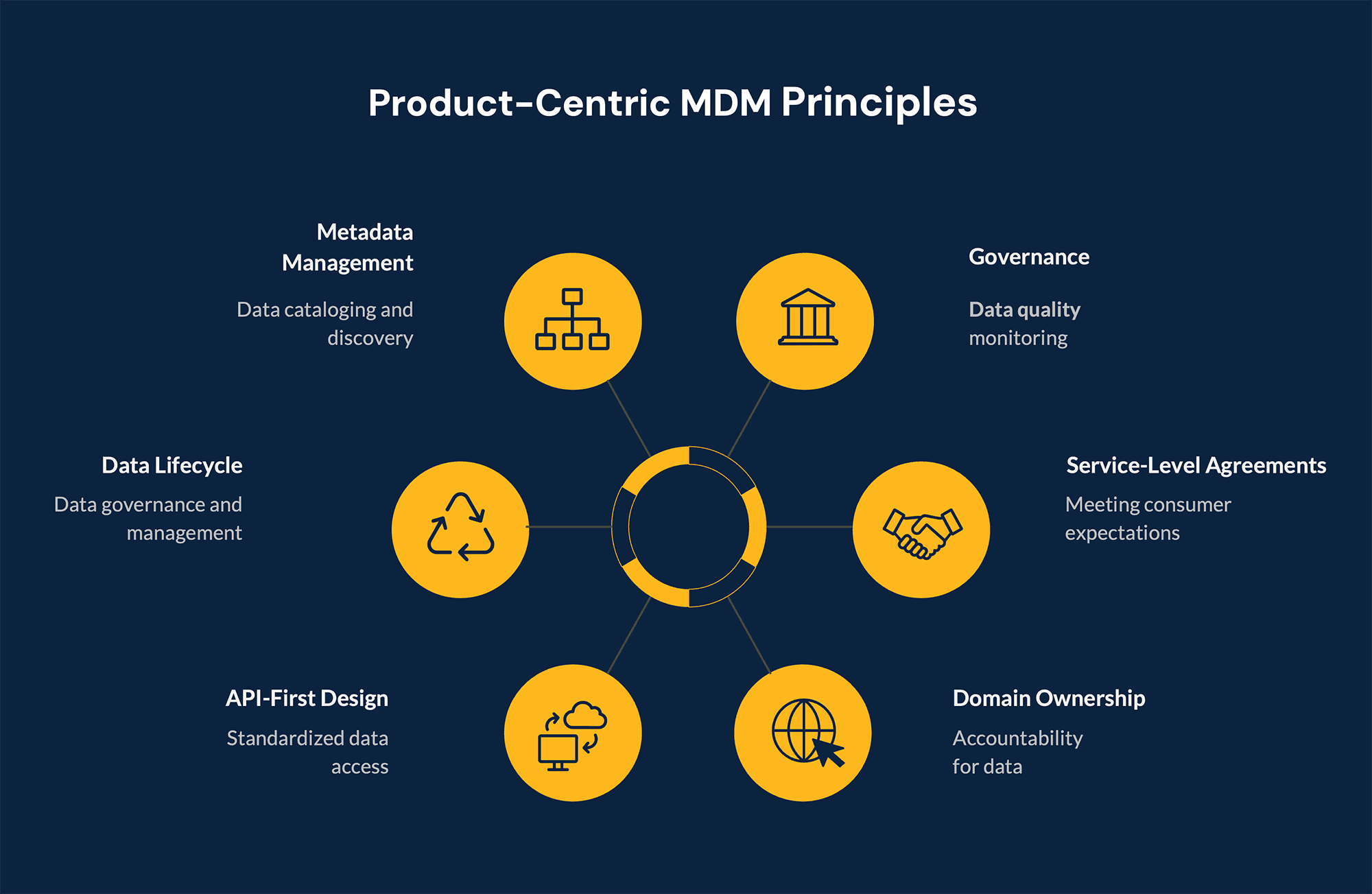
Product-centric MDM rests on five foundational principles. Domain-oriented ownership places accountability for data quality, governance, and lifecycle within business domains, improving relevance and responsiveness. Data as a product requires defined quality standards, documentation, and SLAs. API-first design ensures standardized, scalable access. Strong metadata management and cataloging drive discoverability. Finally, continuous quality monitoring, lineage tracking, and stewardship embed governance and trust.
Operationalizing MDM through data products and domain ownership
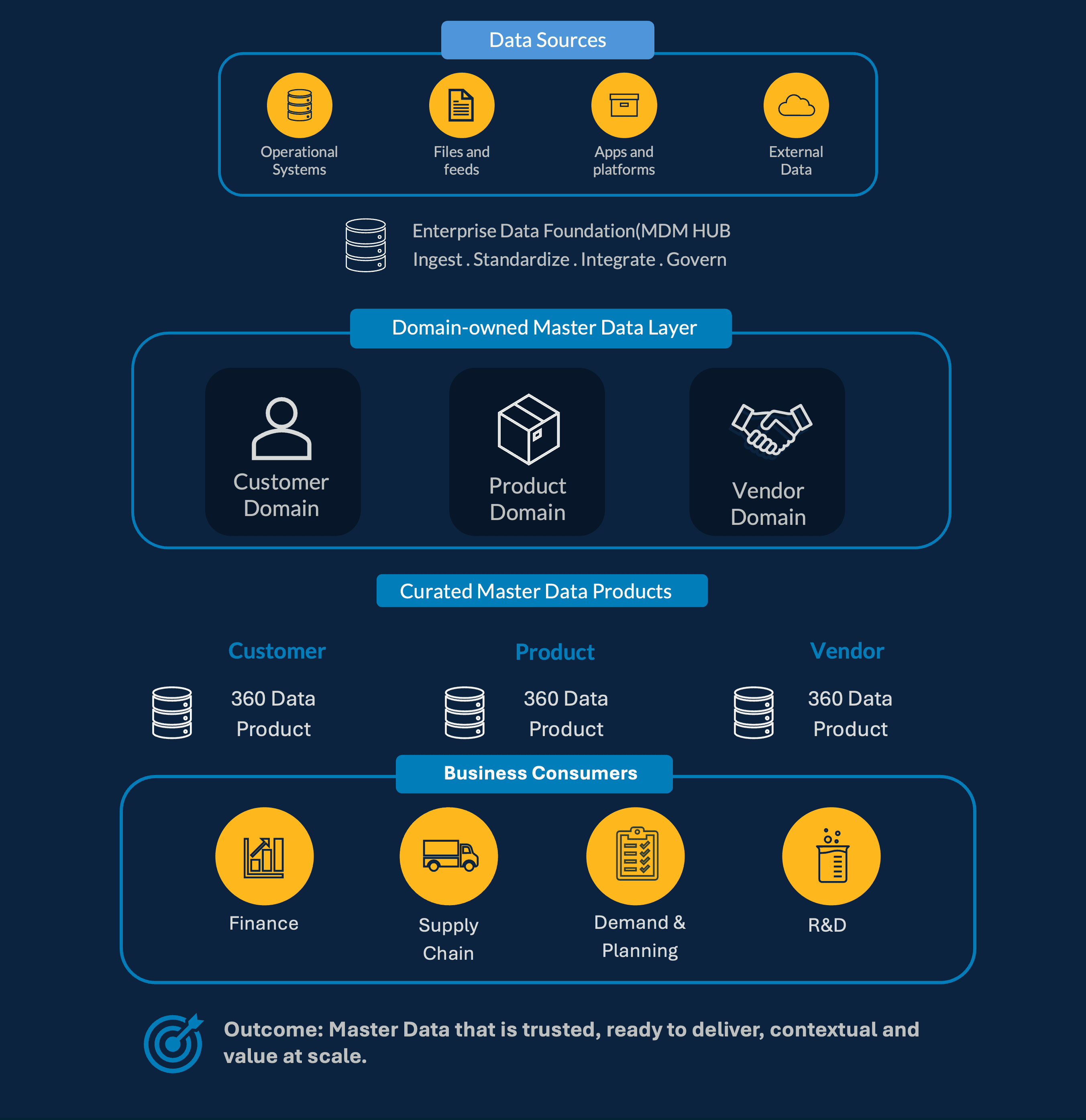
The architecture below illustrates MDM’s evolution into a domain-driven, data product-centric model. Enterprise data is first consolidated in a foundational layer, then organized into domain-specific master data layers aligned to business functions.
Within each domain, data is transformed into curated products enriched with governance, quality controls, and contextual relevance — made available to Finance, Supply Chain, Demand Planning, and other business units.
This shifts MDM from a centralized control mechanism to a scalable, federated ecosystem where data is domain-owned, designed for consumption, and continuously improved, enabling faster insights and greater business agility.
The resulting data products serve business users, analytical platforms, and AI agents that automate activities.
Traditional MDM vs. data product MDM
Traditional MDM operates as a centralized hub, creating a single static version of truth managed by a central custodian via rigid platforms. While this ensures consistency, it limits scalability, contextual relevance, and consumption speed across business domains.
This model evolves by embedding MDM within a data mesh architecture, packaging master data as domain-owned products rather than managing it centrally. AI agents can interact with these products as trusted, reusable building blocks, enabling intelligent automation while preserving governance and consistency.
This shift delivers:
From static to contextual intelligence: Enables context-aware master data products tailored to the needs of each domain.
From centralized ownership to federated governance: Ensures accountability, faster updates, and closer alignment with business realities.
From data assets to consumable data products: Ready-to-use, high-quality data products with clear SLAs, metadata, and discoverability.
From rigid platforms to flexible ecosystems: Supports a tool-agnostic, interoperable architecture while maintaining governance standards.
From limited utility to scalable value creation: Master data becomes a scalable enterprise asset, accelerating analytics, AI, and business outcomes.
Aspect | Traditional MDM | Data Product MDM |
|---|---|---|
Data Perspective | One-size-fits-all master data definitions | Context-aware master data products tailored to domains |
Ownership | Centralized custodians own and manage | Domain owners lead with federated governance |
Nature of Data | Static, aggregated, periodically updated | Domain owners lead with federated governance |
Consumption Model | Static, aggregated, periodically updated | Static, aggregated, periodically updated |
Technology Approach | Tightly coupled to specific platforms | Flexible, interoperable, tool-agnostic |
Business Impact | Limited reuse and slower value delivery | Scalable reuse, faster insights, higher business impact |
Use case: Product-centric supplier MDM data product
Problem statement
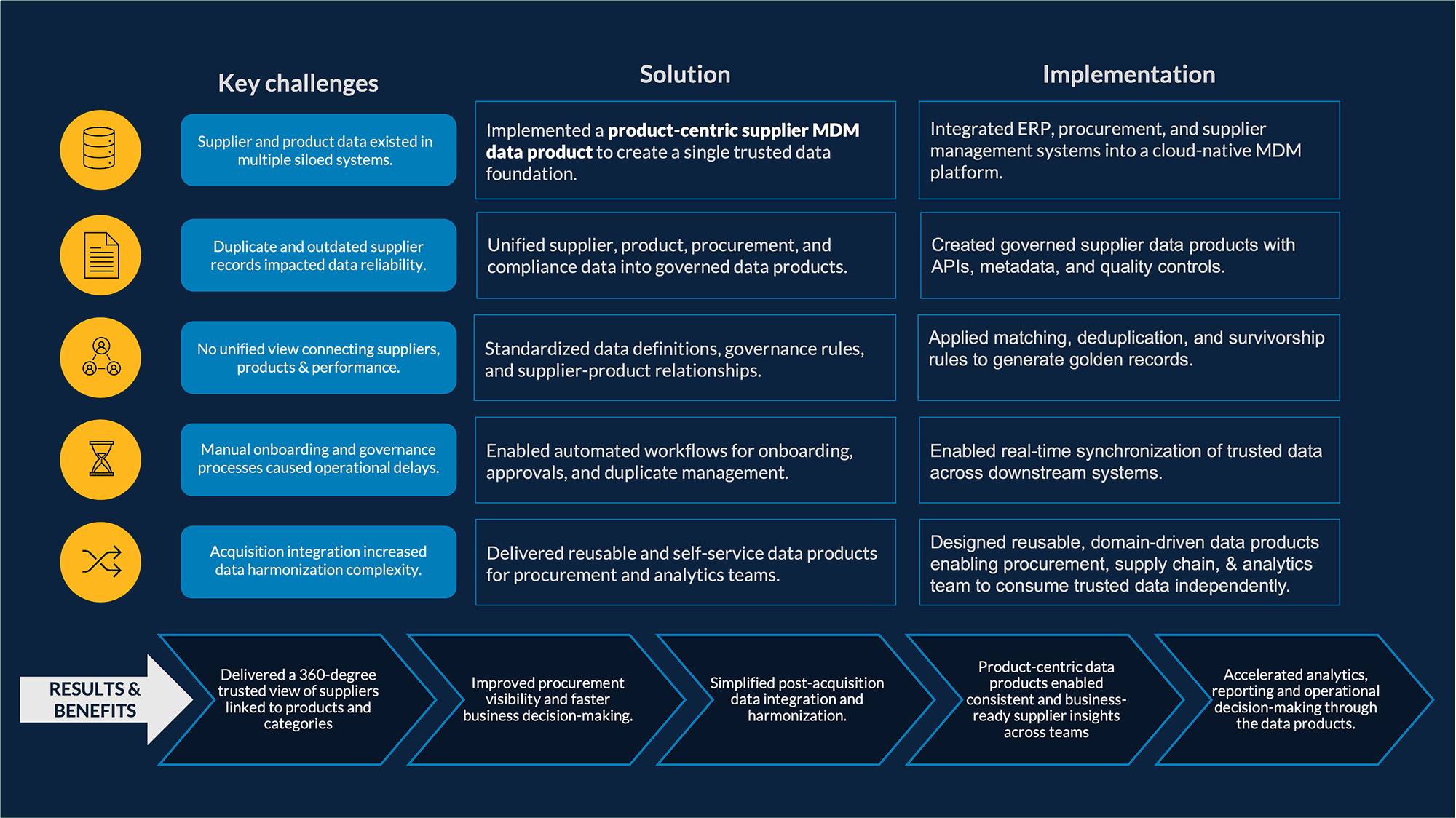
A global manufacturing company struggled to manage supplier and product data across disconnected systems, resulting in duplicate records, inconsistent product mappings, poor procurement visibility, and delayed onboarding and compliance. The organization needed a product-centric data product approach to deliver trusted, reusable, and business-ready master data across the enterprise.
Conclusion
Repositioning MDM as a data product platform moves the organization from siloed, project-based data management to a scalable, reusable, and value-driven model. It improves data quality and consistency while accelerating accessibility and cross-domain collaboration. The transition demands real organizational change: domain ownership, a product mindset, and cultural alignment. The long-term gains in agility, innovation, and decision-making justify the effort. As modern data architectures mature, MDM becomes the trusted foundation for scaling AI and AI-agent use cases, giving intelligent systems access to accurate, governed, and contextually relevant information.
From application-centric to product-centric thinking
A product-centric approach treats data as a product rather than a byproduct of applications.
Core Idea: Master data is designed, managed, and delivered as a reusable, high-quality product serving multiple consumers across the enterprise, turning MDM into a platform that creates, governs, and distributes those products.
In this model, MDM evolves from a system of record into a comprehensive data product platform, aligning with data mesh principles where data is owned by domains. It curates and standardizes master data into reusable products: governed golden records enriched with metadata, business definitions, and embedded quality controls, exposed through well-defined APIs or data services. This enables AI models and intelligent agents to access governed enterprise information via standardized interfaces, reducing the risk of inconsistent or untrusted outputs.
Core principles of product-centric MDM
Product-centric MDM rests on five foundational principles. Domain-oriented ownership places accountability for data quality, governance, and lifecycle within business domains, improving relevance and responsiveness. Data as a product requires defined quality standards, documentation, and SLAs. API-first design ensures standardized, scalable access. Strong metadata management and cataloging drive discoverability. Finally, continuous quality monitoring, lineage tracking, and stewardship embed governance and trust.
Operationalizing MDM through data products and domain ownership
The architecture below illustrates MDM’s evolution into a domain-driven, data product-centric model. Enterprise data is first consolidated in a foundational layer, then organized into domain-specific master data layers aligned to business functions.
Within each domain, data is transformed into curated products enriched with governance, quality controls, and contextual relevance — made available to Finance, Supply Chain, Demand Planning, and other business units.
This shifts MDM from a centralized control mechanism to a scalable, federated ecosystem where data is domain-owned, designed for consumption, and continuously improved, enabling faster insights and greater business agility.
The resulting data products serve business users, analytical platforms, and AI agents that automate activities.
Traditional MDM vs. data product MDM
Traditional MDM operates as a centralized hub, creating a single static version of truth managed by a central custodian via rigid platforms. While this ensures consistency, it limits scalability, contextual relevance, and consumption speed across business domains.
This model evolves by embedding MDM within a data mesh architecture, packaging master data as domain-owned products rather than managing it centrally. AI agents can interact with these products as trusted, reusable building blocks, enabling intelligent automation while preserving governance and consistency.
This shift delivers:
From static to contextual intelligence: Enables context-aware master data products tailored to the needs of each domain.
From centralized ownership to federated governance: Ensures accountability, faster updates, and closer alignment with business realities.
From data assets to consumable data products: Ready-to-use, high-quality data products with clear SLAs, metadata, and discoverability.
From rigid platforms to flexible ecosystems: Supports a tool-agnostic, interoperable architecture while maintaining governance standards.
From limited utility to scalable value creation: Master data becomes a scalable enterprise asset, accelerating analytics, AI, and business outcomes.
Aspect | Traditional MDM | Data Product MDM |
|---|---|---|
Data Perspective | One-size-fits-all master data definitions | Context-aware master data products tailored to domains |
Ownership | Centralized custodians own and manage | Domain owners lead with federated governance |
Nature of Data | Static, aggregated, periodically updated | Domain owners lead with federated governance |
Consumption Model | Static, aggregated, periodically updated | Static, aggregated, periodically updated |
Technology Approach | Tightly coupled to specific platforms | Flexible, interoperable, tool-agnostic |
Business Impact | Limited reuse and slower value delivery | Scalable reuse, faster insights, higher business impact |
Use case: Product-centric supplier MDM data product
Problem statement
A global manufacturing company struggled to manage supplier and product data across disconnected systems, resulting in duplicate records, inconsistent product mappings, poor procurement visibility, and delayed onboarding and compliance. The organization needed a product-centric data product approach to deliver trusted, reusable, and business-ready master data across the enterprise.
Conclusion
Repositioning MDM as a data product platform moves the organization from siloed, project-based data management to a scalable, reusable, and value-driven model. It improves data quality and consistency while accelerating accessibility and cross-domain collaboration. The transition demands real organizational change: domain ownership, a product mindset, and cultural alignment. The long-term gains in agility, innovation, and decision-making justify the effort. As modern data architectures mature, MDM becomes the trusted foundation for scaling AI and AI-agent use cases, giving intelligent systems access to accurate, governed, and contextually relevant information.
Recognition and achievements
Select Fractal accolades

Leader
The Forrester Wave: Customer Analytics Services Q2, 2025

Representative vendor
Gartner Hype Cycle for Consumer Goods, 2026

Great Place to Work
Great Place to Work® across four regions: India (9th year), USA (5th year), UK (5th year) and UAE (2nd year)
Recognition and achievements
Select Fractal accolades
Leader
The Forrester Wave: Customer Analytics Services Q2, 2025
Representative vendor
Gartner Hype Cycle for Consumer Goods, 2026
Great Place to Work
Great Place to Work® across four regions: India (9th year), USA (5th year), UK (5th year) and UAE (2nd year)